Introduction
Can GHK-Cu help wounds heal faster and support the regeneration of damaged skin?
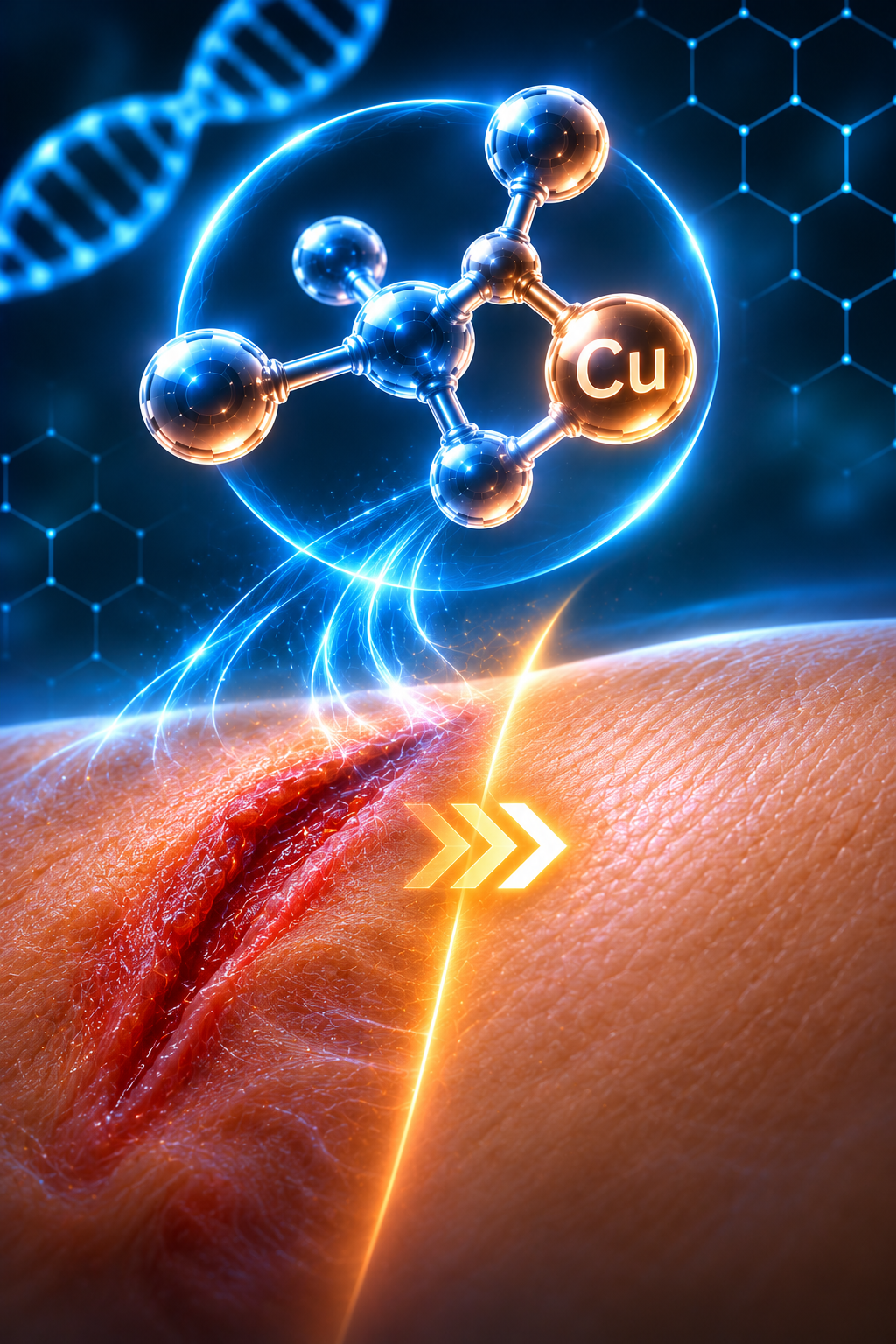
GHK-Cu, a naturally occurring copper peptide, has attracted scientific interest for its potential role in wound healing, tissue repair, and skin regeneration.
When skin is injured, the body activates a complex healing process involving collagen production, inflammation, cellular regeneration, and tissue remodeling.
Research suggests that GHK-Cu may influence several of these processes, making it a promising compound in regenerative peptide research.
Studies investigating GHK-Cu and related peptide mechanisms have reported encouraging findings involving collagen synthesis, tissue remodeling, and wound repair.
Unlike compounds that influence only one aspect of healing, GHK-Cu has demonstrated biological activity across multiple pathways involved in rebuilding damaged tissue.
But how strong is the evidence that GHK-Cu can accelerate wound healing?
This Quick Read explores the science behind GHK-Cu wound healing benefits, including its effects on collagen production, skin regeneration, and the body's natural tissue-repair processes.
Research Background
What Is GHK-Cu and How Does It Support Tissue Repair?
GHK-Cu is a naturally occurring copper-binding peptide composed of three amino acids: glycine, histidine, and lysine.
Originally identified through research involving human plasma, GHK has since attracted attention for its biological activity in skin regeneration, collagen production, and tissue repair.
When GHK binds to copper, it forms the GHK-Cu complex, which researchers have investigated for its potential regenerative properties.
What makes GHK-Cu particularly interesting for wound healing is its ability to influence several biological processes involved in repairing damaged tissue.
Laboratory research suggests that GHK-Cu can affect:
Collagen production: Promoting collagen synthesis in experimental fibroblast models, a process essential for rebuilding damaged skin.
Cellular repair: Influencing fibroblast activity and extracellular matrix production involved in tissue regeneration.
Inflammation: Modulating inflammatory signaling that can affect the healing environment.
Tissue remodeling: Supporting biological processes involved in reorganizing and strengthening connective tissue.
These mechanisms are important because successful wound healing requires more than simply closing an injury. The body must rebuild structural proteins, coordinate cellular activity, and restore damaged tissue.
GHK-Cu's involvement in multiple repair-related pathways makes it a promising compound for wound-healing and skin-regeneration research.
These findings provide the foundation for investigating whether its regenerative activity can translate into improved wound-healing outcomes.
Main Research Findings
1. GHK-Cu Stimulates Collagen Production During Wound Repair
One of the strongest findings in GHK-Cu wound-healing research involves its ability to stimulate collagen synthesis.
Collagen provides the structural framework needed to rebuild damaged skin and connective tissue.
A 1988 study published in FEBS Letters demonstrated that GHK-Cu stimulated collagen production in cultured fibroblasts, the cells responsible for producing much of the connective tissue involved in wound repair.
Importantly, this increase occurred independently of changes in cell number, suggesting a direct influence on collagen synthesis.
These findings provide experimental evidence that GHK-Cu can activate an important biological process involved in tissue regeneration.
2. Animal Research Shows Increased Tissue Repair Activity
A 1993 study published in the Journal of Clinical Investigation examined GHK-Cu in experimental rat wounds.
Researchers observed concentration-dependent increases in several components associated with tissue repair, including:
Collagen accumulation
Total protein content
DNA content
Glycosaminoglycans, which contribute to the extracellular matrix
Collagen synthesis increased approximately twice as much as noncollagen protein synthesis, demonstrating a particularly strong response in connective tissue production.
These findings suggest that GHK-Cu can stimulate the rebuilding of structural components essential for wound repair.
3. GHK-Cu Formulations Have Accelerated Wound Healing in Experimental Models
More recent research has investigated whether GHK-Cu can improve wound closure and skin regeneration.
A 2023 study published in Acta Biomaterialia examined a specialized hydrogel containing copper-complexed GHK peptide nanofibers.
Researchers reported improved wound healing in experimental models, including increased fibroblast activity, collagen remodeling, and blood vessel formation.
The GHK-Cu-containing hydrogel accelerated wound healing in the studied model, providing encouraging evidence of its potential in regenerative wound-care research.
However, these findings involved a specially engineered delivery system and cannot automatically be applied to ordinary GHK-Cu preparations.
What Do These Findings Mean?
Together, these studies demonstrate that GHK-Cu can influence several biological processes essential for repairing damaged tissue.
The strongest evidence supports its ability to stimulate collagen production and extracellular matrix formation, while specialized formulations have demonstrated accelerated wound repair in preclinical research.
Although results vary between experimental models, these findings make GHK-Cu a promising compound for continued wound-healing research.
Current Research Limitations
Although GHK-Cu has demonstrated promising wound-healing properties, most supporting evidence comes from laboratory experiments and animal studies.
Research has shown that GHK-Cu can stimulate collagen production, influence tissue remodeling, and improve certain wound-repair measurements.
However, large, well-controlled human clinical trials have not established that GHK-Cu reliably accelerates wound healing.
Results can also vary depending on the formulation, concentration, delivery method, and experimental model.
While some preclinical studies have reported improved wound healing, others have found limited or no significant improvements.
These differences highlight the importance of further research to determine which experimental conditions produce the most consistent results.
Despite these limitations, GHK-Cu remains a promising subject for wound-healing research because of its demonstrated activity in several biological pathways involved in tissue repair.
Discussion
Why Is GHK-Cu Promising for Wound Healing and Tissue Repair?
What makes GHK-Cu particularly interesting in wound-healing research is its potential to influence several stages of the repair process.
Healing damaged skin requires more than producing new cells. The body must rebuild collagen, restore connective tissue, regulate inflammation, and reorganize the extracellular matrix.
GHK-Cu has demonstrated biological activity in several of these essential repair mechanisms.
Laboratory studies have shown increased collagen synthesis, while animal research has reported improvements in connective tissue formation and selected wound-healing outcomes.
These findings suggest that GHK-Cu may help create conditions that support tissue regeneration rather than influencing just one aspect of healing.
Its effects on collagen production are especially important because collagen provides the structural foundation for repairing damaged skin.
The combination of collagen stimulation, extracellular matrix remodeling, and regenerative signaling makes GHK-Cu a compelling candidate for further wound-healing research.
Although human clinical evidence remains limited, the existing findings provide a scientific basis for continued investigation into GHK-Cu and its potential role in wound repair.
Conclusion
GHK-Cu has emerged as a promising copper peptide in research involving wound healing, skin regeneration, and tissue repair.
Scientific studies have demonstrated that GHK-Cu can stimulate collagen production, influence extracellular matrix formation, and support biological processes involved in rebuilding damaged tissue.
Preclinical investigations have also reported improvements in certain wound-healing outcomes, providing encouraging evidence of its regenerative potential.
What makes GHK-Cu particularly interesting is its ability to influence multiple mechanisms involved in wound repair rather than targeting a single biological process.
Although additional human clinical research is needed to establish its effectiveness and safety, existing laboratory and animal findings provide a strong scientific rationale for continued investigation.
The key takeaway: GHK-Cu has demonstrated promising wound-repair activity in experimental research, particularly through its effects on collagen synthesis and tissue remodeling.
At Peptide Purity USA, we emphasize research material quality, analytical transparency, and scientifically grounded education to support ongoing peptide research.
Research Use Only: All research materials offered by Peptide Purity USA are intended strictly for laboratory research purposes. Not for human or veterinary consumption. Not intended for diagnostic or therapeutic applications.
References
- 1. Maquart, F. X., Pickart, L., Laurent, M., Gillery, P., Monboisse, J. C., & Borel, J. P. (1988). Stimulation of collagen synthesis in fibroblast cultures by the tripeptide-copper complex glycyl-L-histidyl-L-lysine-Cu2+. FEBS Letters, 238(2), 343–346. DOI: 10.1016/0014-5793(88)80509-X.
- 2. Maquart, F. X., Bellon, G., Chaqour, B., et al. (1993). In vivo stimulation of connective tissue accumulation by the tripeptide-copper complex glycyl-L-histidyl-L-lysine-Cu2+ in rat experimental wounds. Journal of Clinical Investigation, 92(5), 2368–2376. DOI: 10.1172/JCI116842.
- 3. Lee, S., Lee, S. M., Lee, S. H., et al. (2023). In situ photo-crosslinkable hyaluronic acid-based hydrogel embedded with GHK peptide nanofibers for bioactive wound healing. Acta Biomaterialia. PMID: 37832839.
- 4. Parker, N. P., Ardeshirpour, F., Schmechel, S. C., & Lassig, A. A. D. (2013). Effects of topical copper tripeptide complex on wound healing in an irradiated rat model. Otolaryngology–Head and Neck Surgery, 149(3), 384–389. DOI: 10.1177/0194599813492644.
- 5. Pickart, L., & Margolina, A. (2015). GHK peptide as a natural modulator of multiple cellular pathways in skin regeneration. BioMed Research International, 2015, Article 648108. DOI: 10.1155/2015/648108.