Introduction
When it comes to vitamin B12, the amount you take isn't necessarily the amount your body absorbs.
Vitamin B12 is an essential nutrient that supports red blood cell formation, neurological function, DNA synthesis, and normal cellular metabolism.
Although vitamin B12 is widely available in oral supplements, it can also be administered through intramuscular injections. Both methods provide the same essential nutrient, but the way B12 enters the bloodstream differs significantly.
Oral B12 must pass through the digestive system, where absorption is limited by several biological factors. Injectable B12 bypasses these gastrointestinal barriers, allowing the vitamin to enter systemic circulation through a more direct route.
This difference becomes especially important at higher doses.
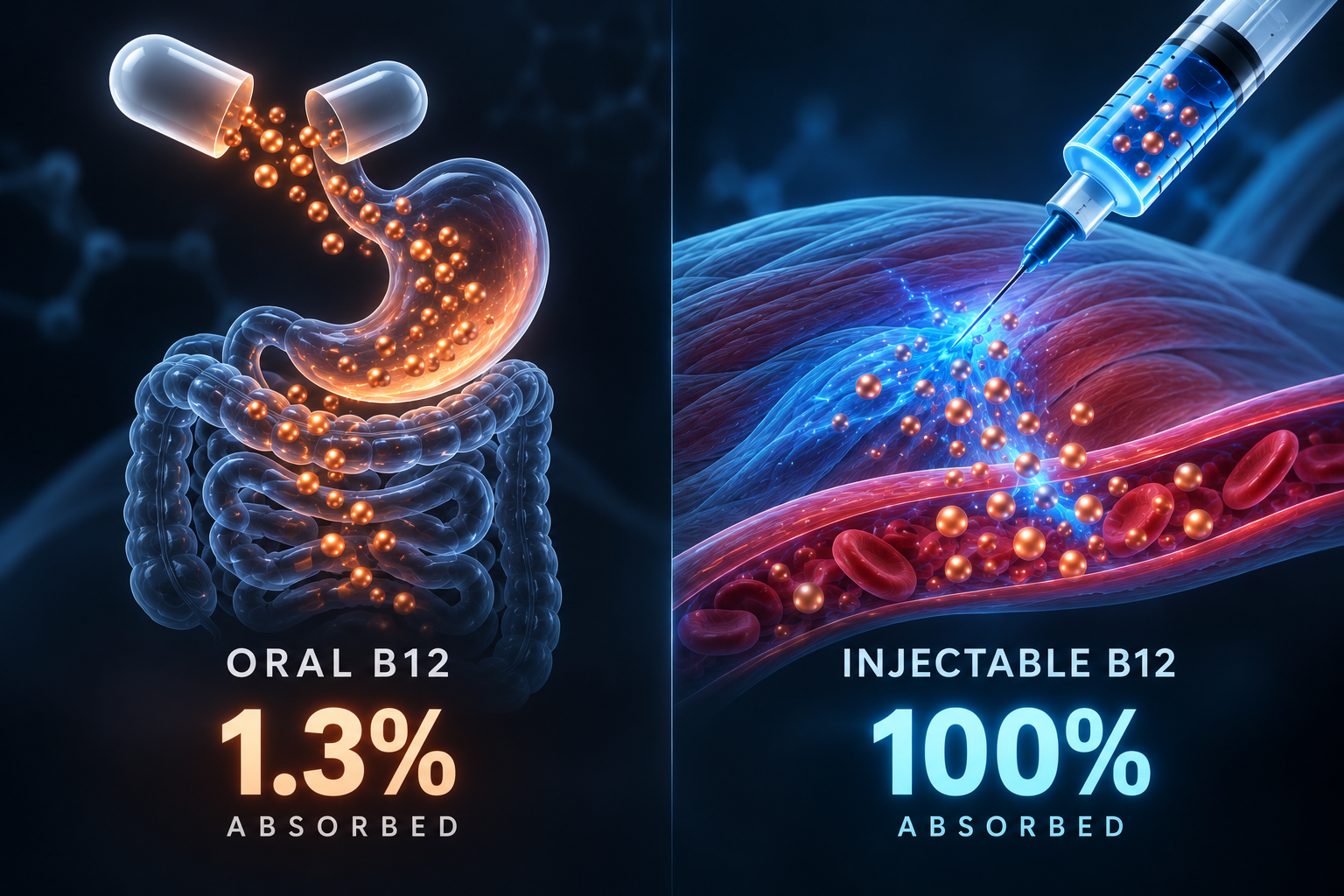
For example, research indicates that the body may absorb only approximately 1.3% of a 1,000 mcg oral B12 supplement, meaning roughly 13 mcg reaches circulation.
Intramuscular injections, by comparison, bypass the intestinal absorption process and provide substantially greater systemic delivery of the administered vitamin.
However, greater absorption does not necessarily mean the body retains or utilizes every molecule of B12, nor does it guarantee better clinical outcomes.
So, how much vitamin B12 actually reaches the bloodstream through each method, and why do injections offer such a significant advantage in delivery?
This Quick Read explores the science behind B12 absorption, the differences between oral and injectable administration, and what current research reveals about their effectiveness.
Main Research Findings
How Does the Body Absorb Oral Vitamin B12?
When vitamin B12 is consumed orally, it must pass through the digestive system before entering the bloodstream.
This process depends on several biological factors, including stomach function, a protein called intrinsic factor, and specialized receptors in the small intestine.
Intrinsic factor is produced by the stomach and binds to vitamin B12, allowing it to be absorbed in the terminal ileum, the final section of the small intestine.
However, this absorption pathway has a limited capacity.
Research indicates that intrinsic factor–mediated absorption becomes saturated at approximately 1–2 micrograms of B12 per dose.
Although a small additional amount can enter circulation through passive diffusion, the percentage absorbed decreases substantially as oral doses increase.
This means that taking more oral B12 does not necessarily result in a proportional increase in the amount absorbed.
How Much B12 Does the Body Actually Absorb?
According to the National Institutes of Health (NIH), the percentage of vitamin B12 absorbed from oral supplements decreases as the administered dose increases.
Intramuscular injections work differently, bypassing gastrointestinal absorption and delivering B12 into systemic circulation through muscle tissue.
The following comparison illustrates these differences:
| Administration Method | B12 Dose | Estimated Absorption | Amount Reaching Circulation |
|---|---|---|---|
| Oral B12 | 1 mcg | ~50% | ~0.5 mcg |
| Oral B12 | 500 mcg | ~2% | ~10 mcg |
| Oral B12 | 1,000 mcg | ~1.3% | ~13 mcg |
| Injectable B12 (IM) | 1,000 mcg | High systemic availability | Substantially greater initial delivery |
Oral absorption percentages are approximate estimates reported by the NIH. Intramuscular B12 bypasses intestinal absorption, but its systemic bioavailability and subsequent retention depend on the formulation and physiological conditions.
Consider a 1,000 mcg dose of vitamin B12.
With oral supplementation, approximately 13 mcg may enter circulation, representing just 1.3% of the administered dose.
With an intramuscular injection, B12 bypasses the intestinal absorption pathway, allowing substantially more of the administered vitamin to reach systemic circulation.
This difference is the primary reason injectable B12 offers a significant advantage in absorption and systemic delivery.
However, absorption does not equal permanent retention. Once B12 enters circulation, the body regulates its distribution, storage, and elimination.
Why Injectable B12 Has an Absorption Advantage
Unlike oral supplementation, injectable B12 does not depend on stomach acid, intrinsic factor production, or specialized intestinal receptors.
Instead, the vitamin is absorbed from the injection site into the bloodstream.
This bypasses several biological barriers that can limit oral B12 absorption, particularly in individuals with gastrointestinal disorders or impaired intrinsic factor production.
The greatest advantage of injectable B12 is its ability to provide more predictable systemic delivery without relying on normal digestive absorption.
However, greater initial delivery does not mean the entire injected dose is retained or utilized.
Excess circulating B12 may be eliminated through the kidneys, while tissue uptake and storage depend on the body's physiological requirements.
Injectable vs. Oral B12: Key Differences
| Comparison | Oral B12 | Injectable B12 |
|---|---|---|
| Administration | Tablet or capsule | Intramuscular injection |
| Requires digestive absorption | Yes | No |
| Depends on intrinsic factor | For active absorption | No |
| High-dose absorption | Small percentage of dose | Bypasses intestinal absorption limits |
| Systemic delivery | Limited by gastrointestinal absorption | More direct and predictable |
| Impaired gastrointestinal absorption | High oral doses may still work | Particularly useful |
| Can correct B12 deficiency | Yes | Yes |
The primary advantage of injectable B12 is not that it contains a more powerful vitamin, but that its administration route bypasses the digestive system's absorption limitations.
Does Better Absorption Mean Injectable B12 Is Always More Effective?
Although injectable B12 provides a clear advantage in bypassing gastrointestinal absorption, greater systemic delivery does not necessarily translate into better clinical outcomes for everyone.
High-dose oral B12 can compensate for its relatively low absorption percentage by supplying enough vitamin to support adequate uptake.
Clinical research has demonstrated that appropriately dosed oral B12 can successfully increase blood B12 concentrations and correct deficiencies in many individuals.
A 2018 Cochrane review found that high-dose oral supplementation may achieve results comparable to intramuscular injections for certain measures of vitamin B12 deficiency, although the available evidence was limited.
Similarly, a 2020 randomized clinical trial found that oral B12 was comparable to injections in normalizing B12 levels over eight weeks, while longer-term findings were less conclusive.
This highlights an important distinction: injectable B12 offers superior delivery past gastrointestinal barriers, but oral supplementation can still be clinically effective.
Injections may be particularly valuable for individuals with severe deficiency, certain gastrointestinal conditions, or impaired intrinsic factor production, especially when rapid and reliable replacement is clinically important.
Ultimately, the most appropriate method depends on individual absorption capacity, the severity and cause of deficiency, and clinical response.
Current Research Limitations
Although injectable B12 offers clear advantages in bypassing gastrointestinal absorption, several limitations must be considered when comparing it with oral supplementation.
Absorption rates can vary depending on the administered dose, B12 formulation, gastrointestinal function, and individual physiology.
Importantly, absorption, bioavailability, retention, and cellular utilization are different biological measurements.
While intramuscular injections allow B12 to enter systemic circulation without relying on intestinal absorption, this does not mean the entire administered dose is permanently retained or utilized by the body.
Excess circulating B12 may be eliminated through urine, while tissue uptake and storage are regulated by physiological processes.
Similarly, although only a small percentage of a high-dose oral supplement may be absorbed, the amount reaching circulation can still be sufficient to correct vitamin B12 deficiency.
Another important limitation involves how clinical effectiveness is measured.
Many studies primarily evaluate serum B12 concentrations rather than long-term neurological outcomes, symptom improvement, or other functional measures.
Additionally, large, long-term clinical trials directly comparing oral and injectable B12 remain limited.
Current evidence supports an important absorption and delivery advantage for injectable B12, but does not establish that injections consistently produce better clinical outcomes than appropriately dosed oral supplementation.
Further research is needed to determine which individuals benefit most from each administration method, particularly those with impaired gastrointestinal absorption or severe vitamin B12 deficiency.
Conclusion
Vitamin B12 absorption depends significantly on how the vitamin is administered, with oral supplements and intramuscular injections following fundamentally different pathways into the bloodstream.
Oral B12 must pass through the gastrointestinal system, where intrinsic factor availability and intestinal absorption capacity limit how much of the administered dose enters circulation.
Research indicates that at an oral dose of 1,000 mcg, approximately 1.3%, or just 13 mcg, may be absorbed.
Injectable B12 bypasses these gastrointestinal limitations, allowing substantially more of the administered vitamin to enter systemic circulation without depending on stomach function, intrinsic factor, or intestinal transport.
This gives injectable B12 a significant advantage in systemic delivery, particularly for individuals with impaired gastrointestinal absorption.
However, greater initial delivery does not necessarily mean greater long-term retention or superior clinical outcomes.
High-dose oral B12 can still provide sufficient absorption to correct deficiencies in many individuals, demonstrating that absorption efficiency and clinical effectiveness are not always directly related.
The most important takeaway is that injectable B12 offers a clear advantage in bypassing digestive absorption barriers, while the most effective method of supplementation depends on individual needs, absorption capacity, and clinical circumstances.
As research continues, a better understanding of B12 absorption, bioavailability, and utilization may help clarify which administration methods provide the greatest benefits for different populations.
At Peptide Purity USA, we emphasize scientifically grounded education, analytical transparency, and responsible laboratory research.
Research Use Only: All research materials offered by Peptide Purity USA are intended strictly for laboratory research purposes. Not for human or veterinary consumption. Not intended for diagnostic or therapeutic applications. This article is provided for educational purposes only and does not constitute medical advice or instructions for self-administration.
References
- 1. National Institutes of Health (NIH), Office of Dietary Supplements. Vitamin B12 — Health Professional Fact Sheet.
- 2. DailyMed, U.S. National Library of Medicine. Cyanocobalamin Injection, USP — Prescribing Information.
- 3. Wang H, Li L, Qin LL, Song Y, Vidal-Alaball J, Liu TH. (2018). Oral vitamin B12 versus intramuscular vitamin B12 for vitamin B12 deficiency. Cochrane Database of Systematic Reviews, 2018(3), CD004655.
- DOI: 10.1002/14651858.CD004655.pub3
- 4. Sanz-Cuesta T, Escortell-Mayor E, Cura-Gonzalez I, et al. (2020). Oral versus intramuscular administration of vitamin B12 for vitamin B12 deficiency in primary care: a pragmatic, randomised, non-inferiority clinical trial (OB12). BMJ Open, 10, e033687.
- DOI: 10.1136/bmjopen-2019-033687