Introduction
What if a naturally occurring peptide could help your skin maintain a firmer, smoother, and more youthful appearance?
As we age, our skin gradually undergoes changes that affect its structure, elasticity, and ability to maintain a healthy appearance.
One of the most significant changes involves collagen, the structural protein responsible for much of the skin's firmness and strength.
Over time, collagen production generally declines, while changes in existing collagen fibers contribute to fine lines, wrinkles, and reduced skin elasticity.
These changes have led researchers to investigate compounds that may influence the biological processes associated with skin aging.
One compound attracting particular interest is GHK-Cu, a naturally occurring copper-binding peptide.
Unlike skincare ingredients that primarily provide temporary hydration or surface-level improvements, GHK-Cu has been investigated for its potential effects on collagen production, tissue remodeling, and cellular repair mechanisms.
Laboratory research suggests that GHK-Cu may influence several pathways involved in maintaining skin structure, while small human studies involving topical copper-peptide formulations have reported improvements in selected measurements of skin firmness, density, and wrinkle appearance.
However, these findings remain preliminary, and larger clinical studies are needed to determine whether copper peptides consistently produce meaningful improvements in aging skin.
So, can copper peptides actually help your skin look younger, or are their anti-aging benefits still largely experimental?
This Quick Read explores the science behind GHK-Cu, its potential effects on collagen and wrinkles, and what current research reveals about its role in skin aging.
Research Background
Copper peptides are compounds formed when certain peptides, which are short chains of amino acids, bind to copper ions.
One of the most widely studied examples is GHK-Cu (glycyl-L-histidyl-L-lysine copper).
GHK is a naturally occurring tripeptide composed of three amino acids: glycine, histidine, and lysine.
When GHK binds to a copper ion, it forms the GHK-Cu complex, which has attracted scientific interest for its potential involvement in tissue repair, collagen regulation, and skin maintenance.
Copper itself plays an important role in maintaining healthy connective tissue.
For example, copper is required for the activity of certain enzymes involved in strengthening and stabilizing collagen and elastin fibers.
These structural proteins help skin maintain its firmness, elasticity, and overall appearance.
Laboratory investigations suggest that GHK-Cu may influence fibroblasts, the specialized cells responsible for producing collagen and other components of the skin's supporting structure.
Researchers have also observed changes in cellular signaling and extracellular matrix remodeling, processes involved in maintaining and reorganizing the structural framework of skin.
What makes GHK-Cu particularly interesting is its potential to influence the biological processes associated with skin structure, rather than simply improving the skin's surface appearance.
However, while these findings provide a scientific foundation for further investigation, they do not establish that GHK-Cu reliably produces visible anti-aging benefits in humans.
Main Research Findings
Can Copper Peptides Increase Collagen Production?
One of the most promising areas of GHK-Cu research involves its potential influence on collagen production and skin structure.
Collagen is the most abundant protein in human skin, providing much of the strength and structural support that helps maintain a firm, youthful appearance.
As we age, collagen production generally decreases, while existing collagen fibers undergo changes that contribute to wrinkles, sagging, and reduced skin elasticity.
Researchers have investigated whether GHK-Cu can influence the cellular processes responsible for maintaining and remodeling these structural proteins.
Laboratory studies have demonstrated that GHK-Cu can affect fibroblasts, the specialized cells responsible for producing collagen and other components of the extracellular matrix.
The extracellular matrix is the network of proteins and other molecules that surrounds cells and helps maintain the skin's structure.
Experimental findings suggest that GHK-Cu may influence several collagen-related processes, including:
Collagen synthesis: Cellular activity involved in producing new collagen proteins.
Fibroblast activity: The function of cells responsible for maintaining the skin's structural framework.
Extracellular matrix remodeling: The ongoing process of breaking down, replacing, and reorganizing structural proteins.
Tissue maintenance: Biological processes that help preserve the organization and integrity of connective tissue.
Interestingly, GHK-Cu research has also identified potential effects on enzymes involved in collagen breakdown and remodeling.
This suggests that its biological activity may involve more than simply stimulating collagen production.
GHK-Cu may influence the balance between collagen formation and degradation, two processes that play important roles in maintaining skin structure as we age.
However, most of these findings come from laboratory investigations, and researchers have not conclusively demonstrated that topical GHK-Cu consistently increases collagen production or reverses collagen loss in human skin.
While the available evidence provides a promising foundation for skin-aging research, larger controlled human studies are needed to determine whether these biological effects translate into meaningful improvements in skin firmness and appearance.
Can Copper Peptides Reduce Wrinkles and Improve Skin Firmness?
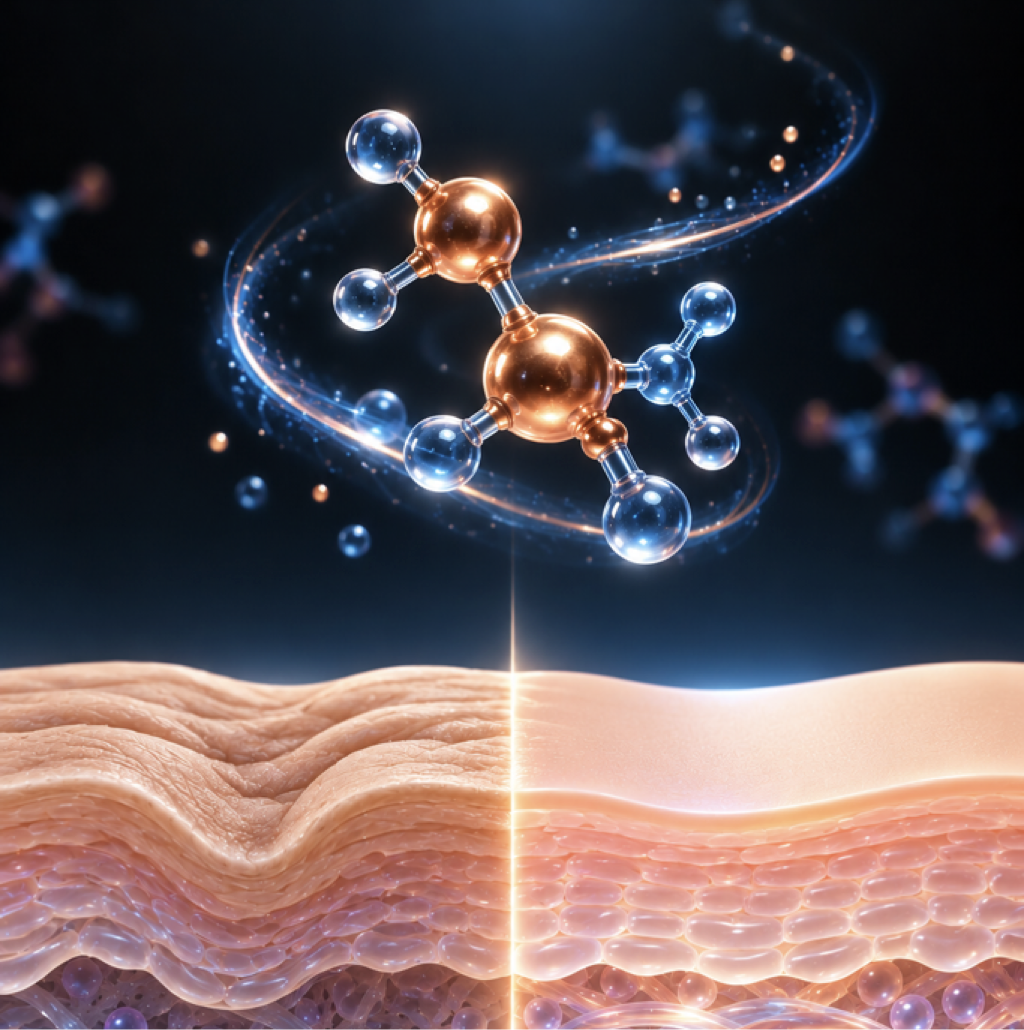
While laboratory research suggests that GHK-Cu may influence collagen production, an important question remains: Can these biological effects translate into visible improvements in aging skin?
Some small human studies involving topical copper-peptide formulations have reported encouraging results.
Researchers have investigated whether these formulations can improve skin firmness, elasticity, texture, and the appearance of fine lines and wrinkles.
In certain investigations lasting approximately 12 weeks, participants using copper-peptide skincare products experienced improvements in selected measurements of skin appearance.
Reported findings have included:
Improved skin firmness: Changes in measurements associated with skin tightness and structural support.
Reduced wrinkle appearance: Improvements in the visible depth or appearance of certain fine lines and wrinkles.
Increased skin density: Changes in measurements associated with the skin's structural characteristics.
Improved skin texture: Observations of smoother or more even-looking skin.
These findings suggest that copper peptides may have potential applications in cosmetic skin-aging research.
However, the available clinical evidence remains limited.
Several frequently cited studies involved relatively small participant groups, while others have incomplete published methodological details.
Additionally, not all human investigations have demonstrated significant improvements.
For example, a small randomized clinical study examining a copper-peptide skincare regimen following laser resurfacing did not demonstrate significant improvements in objective wrinkle measurements or overall skin quality compared with the control regimen.
These differences highlight the importance of considering formulation, study design, treatment duration, and the methods used to evaluate skin changes.
Although some human studies suggest that copper peptides may improve the appearance of aging skin, current evidence does not establish that GHK-Cu consistently reduces wrinkles or significantly improves skin firmness.
Larger, well-controlled clinical trials are needed to determine whether these early findings can be reproduced and whether the observed improvements are meaningful over time.
Can Copper Peptides Help Repair Aging Skin?
Skin aging involves more than the gradual loss of collagen.
Over time, changes in cellular activity, oxidative stress, inflammation, and tissue-repair processes can affect the skin's ability to maintain its structure and appearance.
Researchers have investigated whether GHK-Cu may influence some of the biological mechanisms involved in maintaining and repairing skin tissue.
Laboratory and preclinical investigations suggest that GHK-Cu may interact with several important processes, including:
Tissue remodeling: Biological processes involved in repairing, replacing, and reorganizing damaged or aging tissue.
Cellular repair: Activity associated with wound healing, cell migration, and tissue regeneration.
Oxidative stress regulation: Mechanisms that help cells respond to oxidative damage, which can contribute to skin aging.
Inflammatory signaling: Cellular pathways involved in regulating inflammation and maintaining tissue health.
These findings suggest that GHK-Cu may have biological effects extending beyond collagen production alone.
For example, experimental wound-healing research has reported changes in tissue organization, cellular activity, and repair-associated processes following exposure to GHK-Cu.
Researchers have also investigated its potential influence on antioxidant and inflammatory pathways that may contribute to tissue maintenance.
What makes GHK-Cu particularly interesting is its potential involvement in multiple biological processes associated with maintaining healthy skin structure.
However, most of these findings come from laboratory experiments and animal studies rather than controlled human skin-aging trials.
Additionally, improving tissue repair following an experimental injury is not the same as reversing the gradual biological changes associated with aging.
Although GHK-Cu has demonstrated promising tissue-repair activity in preclinical research, current evidence does not establish that it can reverse skin aging or restore youthful skin in humans.
Further research is necessary to determine whether these biological effects translate into measurable improvements in long-term skin health and appearance.
Current Research Limitations
Although GHK-Cu has demonstrated promising biological activity in laboratory and preclinical investigations, several important limitations remain.
One of the biggest challenges is the lack of large, well-controlled human clinical trials examining its effectiveness for skin aging.
Much of the supporting evidence comes from laboratory experiments, animal studies, and relatively small human investigations.
While some studies have reported improvements in skin firmness, density, and wrinkle appearance, these findings have not been consistently confirmed through large, independently replicated clinical trials.
Another important consideration is skin absorption.
The skin's outer protective barrier can limit how effectively peptides penetrate into deeper tissue layers, where many collagen-producing cells are located.
This means that the biological effects observed when GHK-Cu is applied directly to cells in laboratory experiments may not occur to the same extent when it is incorporated into a topical skincare product.
Formulation differences also complicate the interpretation of existing research.
Copper-peptide products may contain different concentrations, delivery systems, and additional ingredients, making it difficult to determine whether observed improvements result specifically from GHK-Cu.
Researchers must also establish whether repeated exposure produces consistent benefits and evaluate the long-term safety of different formulations.
Most importantly, evidence that GHK-Cu influences collagen production or tissue-repair pathways does not demonstrate that it can reverse biological skin aging in humans.
Although current findings support continued investigation, larger clinical studies are necessary to determine whether copper peptides provide meaningful, reproducible, and lasting improvements in skin appearance.
Discussion
Although GHK-Cu has demonstrated interesting biological activity, several important questions remain unanswered.
Much of the strongest evidence comes from laboratory experiments rather than large human clinical trials.
Existing human studies are generally small, and some lack the methodological detail necessary to establish reliable conclusions.
Another important consideration is skin absorption.
Peptides can have difficulty penetrating the skin's outer protective barrier, meaning the effectiveness of a topical formulation may depend on how successfully the compound reaches its intended biological target.
Researchers also need to determine whether observed cosmetic improvements result from GHK-Cu itself, other ingredients in the formulation, or their combined effects.
Long-term safety and effectiveness across different concentrations and delivery methods also require further investigation.
Most importantly, current research does not demonstrate that GHK-Cu reverses biological skin aging or reliably restores youthful skin structure in humans.
These limitations are especially important when distinguishing scientifically supported findings from exaggerated anti-aging claims.
Conclusion
Copper peptides, particularly GHK-Cu, represent a promising area of scientific research involving skin aging, collagen production, and tissue maintenance.
Laboratory investigations have demonstrated that GHK-Cu can influence biological processes associated with collagen synthesis, fibroblast activity, and extracellular matrix remodeling.
Preclinical studies have also identified potential effects on tissue repair, inflammatory signaling, and cellular mechanisms involved in maintaining skin structure.
Some small human studies involving topical copper-peptide formulations have reported improvements in selected measurements of skin firmness, density, and wrinkle appearance.
However, these findings remain limited by small study sizes, formulation differences, and insufficient independent clinical replication.
So, can copper peptides actually help your skin look younger?
Current research suggests that GHK-Cu may have the potential to improve certain aspects of skin appearance, particularly those associated with collagen regulation and tissue structure.
However, while the early findings are encouraging, copper peptides have not been conclusively demonstrated to reverse skin aging or consistently produce significant cosmetic improvements in humans.
Further well-controlled clinical studies are necessary to determine their effectiveness, long-term safety, and potential applications in skin-aging research.
At Peptide Purity USA, we emphasize scientifically grounded education, research material quality, analytical transparency, and responsible laboratory practices.
Research Use Only: All research materials offered by Peptide Purity USA are intended strictly for laboratory research purposes. Not for human or veterinary consumption. Not intended for diagnostic or therapeutic applications.
References
- 1. Pickart & Margolina (2018). Regenerative and Protective Actions of the GHK-Cu Peptide in the Light of the New Gene Data. International Journal of Molecular Sciences.
- 2. Topically Applied GHK as an Anti-Wrinkle Peptide: Advantages, Problems and Prospective. Review of skin penetration, anti-wrinkle mechanisms, and clinical evidence.
- 3. A Systematic Review of the Mechanisms and Therapeutic Applications of GHK-Cu in Topical Microneedle Delivery (2026).