Introduction
Why do some peptides remain in the body for only a few minutes, while others can persist for hours or even days?
The answer often comes down to a scientific concept known as half-life.
When researchers study peptides, understanding how quickly a compound is broken down or eliminated is an important part of evaluating its biological behavior.
Some peptides are rapidly degraded by enzymes, while others remain in circulation for much longer due to differences in their molecular structure, stability, and how the body processes them.
These differences can influence how long a peptide remains detectable, how it interacts with biological systems, and how researchers interpret experimental results.
But what exactly does peptide half-life mean, and does a longer half-life necessarily make a peptide more effective?
This Quick Read explores what peptide half-life is, why it differs between compounds, and why understanding it matters in scientific research.
Main Research Findings
What Is Peptide Half-Life?
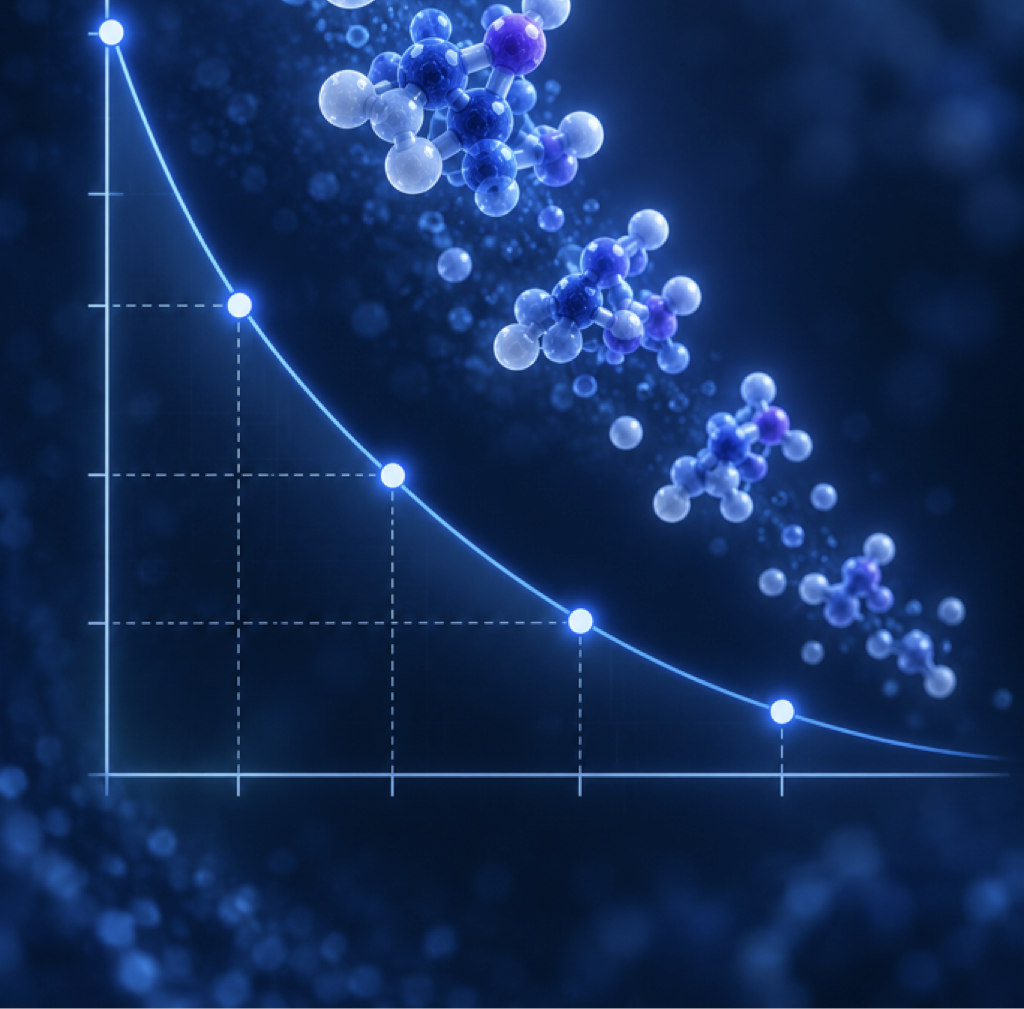
Peptide half-life is the amount of time required for the measured concentration or amount of a peptide to decrease by 50% under defined conditions.
In simpler terms, it describes how quickly the amount of a peptide decreases over time.
For example, imagine a peptide has a circulating half-life of one hour.
If its starting concentration represents 100%, the expected decline would look like this:
| Time | Peptide Remaining |
|---|---|
| Starting point | 100% |
| After 1 hour | 50% |
| After 2 hours | 25% |
| After 3 hours | 12.5% |
| After 4 hours | 6.25% |
This example assumes a simplified model in which the peptide's concentration decreases at a constant proportional rate.
An important detail is that a peptide does not completely disappear after one half-life. Instead, the amount remaining continues to decrease by half with each additional half-life.
In real biological systems, this process can be more complex because peptides may enter different tissues, interact with proteins, or undergo multiple stages of distribution and elimination.
Why Do Different Peptides Have Different Half-Lives?
Not all peptides remain in circulation for the same amount of time.
Some are broken down relatively quickly, while others remain detectable for hours or longer.
These differences depend on several biological and molecular factors.
Molecular Structure
A peptide's amino acid sequence and three-dimensional structure can influence how stable it is and how easily enzymes can break it down.
Enzymatic Degradation
The body contains specialized enzymes called peptidases, which break peptide bonds. Some peptides are more resistant to these enzymes than others.
Kidney and Liver Clearance
The kidneys and liver help process and eliminate many compounds from the body. How much each organ contributes depends on the peptide's characteristics.
Molecular Modifications
Researchers can study chemical modifications, such as attaching fatty acids to peptides, that may influence how they bind to proteins, resist degradation, or are cleared from circulation.
Together, these factors explain why two peptides that influence similar biological pathways can have very different half-lives.
Does a Longer Half-Life Mean a Better Peptide?
Not necessarily.
A longer half-life generally means a peptide's concentration decreases more slowly under the conditions being measured.
However, remaining in circulation longer does not automatically make a peptide more effective or biologically active.
Some biological processes rely on short signaling events, while others may respond to more sustained exposure.
For example, a peptide with a short half-life may activate a receptor and initiate cellular signaling that continues after much of the original compound has been eliminated.
Meanwhile, a peptide with a longer half-life may remain detectable in circulation even when its biological effects have weakened.
Researchers must therefore consider more than half-life alone, including receptor activity, tissue distribution, concentration, and the biological response being investigated.
The key distinction is that half-life measures how quickly a peptide's concentration decreases, not how effectively it performs a biological function.
Half-Life vs. Duration of Action: What's the Difference?
Although these terms are related, they describe two different aspects of peptide behavior.
Half-life refers to the time required for the measured amount or concentration of a peptide to decrease by 50%.
Duration of action refers to how long a measurable biological effect continues.
For example, a peptide may have a short circulating half-life but trigger cellular processes that remain active after its concentration has substantially decreased.
Conversely, a peptide may remain in circulation for an extended period without producing the same level of biological activity throughout that time.
This distinction is important because the amount of time a peptide remains in the body is not necessarily the same as the amount of time its biological effects last.
Understanding both concepts helps researchers interpret peptide behavior more accurately and distinguish pharmacokinetic measurements from biological responses.
Current Research Limitations
Although peptide half-life is an important measurement in scientific research, interpreting it requires an understanding of the conditions under which it was measured.
A peptide's reported half-life can vary depending on several factors, including the species being studied, route of administration, formulation, and methods used to measure its concentration.
Researchers must also distinguish between plasma half-life, elimination half-life, and peptide stability under laboratory storage conditions.
For example, a peptide that remains stable for weeks in a refrigerated laboratory solution will not necessarily remain intact for the same amount of time in the bloodstream.
This is because laboratory storage conditions differ substantially from the biological environment, where enzymes, tissue distribution, and clearance mechanisms can influence how quickly a peptide's concentration decreases.
Additionally, half-life measurements obtained from animal studies cannot automatically be applied to humans, as differences in metabolism and physiological processes may affect peptide behavior.
These limitations highlight why peptide half-life should be interpreted within the context of each study rather than treated as a fixed value that applies under all conditions.
Conclusion
Peptide half-life is an important concept in pharmacokinetic research because it helps scientists understand how peptide concentrations change over time.
While some peptides are rapidly broken down or eliminated, others remain detectable in circulation for considerably longer periods.
These differences are influenced by factors such as molecular structure, enzymatic degradation, biological clearance, and chemical modifications.
However, a longer half-life does not necessarily mean greater biological effectiveness, just as a shorter half-life does not mean a peptide lacks biological significance.
A peptide may produce effects that continue beyond its circulating half-life, while another may remain detectable even after its biological activity has diminished.
The key takeaway is that half-life describes how long a peptide persists, not necessarily how long its effects last or how effective it is.
Understanding this distinction allows researchers to interpret pharmacokinetic measurements more accurately and better evaluate peptide behavior in experimental settings.
At Peptide Purity USA, we emphasize research material quality, analytical transparency, and responsible laboratory practices to support scientific investigation.
Research Use Only: All research materials offered by Peptide Purity USA are intended strictly for laboratory research purposes. Not for human or veterinary consumption. Not intended for diagnostic or therapeutic applications.
References
- 1. Diao, L., & Meibohm, B. (2013). Pharmacokinetics and pharmacokinetic-pharmacodynamic correlations of therapeutic peptides. Clinical Pharmacokinetics, 52(10), 855–868.
- https://doi.org/10.1007/s40262-013-0079-0
- 2. Di, L. (2015). Strategic approaches to optimizing peptide ADME properties. The AAPS Journal, 17(1), 134–143.
- https://doi.org/10.1208/s12248-014-9687-3
- 3. Fosgerau, K., & Hoffmann, T. (2015). Peptide therapeutics: Current status and future directions. Drug Discovery Today, 20(1), 122–128.
- https://doi.org/10.1016/j.drudis.2014.10.003
- 4. Nordell, P., Jansson-Löfmark, R., & Gennemark, P. (2026). Systemic pharmacokinetic principles of therapeutic peptides. Clinical Pharmacokinetics.
- https://doi.org/10.1007/s40262-025-01615-z
- 5. Optimization of protein and peptide drugs based on the mechanisms of kidney clearance. (2018). PubMed.
- https://pubmed.ncbi.nlm.nih.gov/29848260/