Introduction
What tells your muscles to grow, repair themselves, and adapt after physical activity?
Muscle growth is a complex biological process influenced by resistance exercise, nutrition, hormones, and cellular signaling.
One important molecule involved in these processes is insulin-like growth factor 1 (IGF-1), a naturally occurring protein hormone that helps regulate tissue growth, cellular activity, and muscle development.
IGF-1 works closely with growth hormone (GH), but it also plays a distinct role in skeletal muscle biology.
Researchers have investigated how IGF-1 influences muscle protein synthesis, muscle cell development, and the biological processes associated with exercise and tissue repair.
But how does IGF-1 contribute to muscle growth, and does having more IGF-1 necessarily mean building more muscle?
This Quick Read explores what IGF-1 is, how it works, and what scientific research reveals about its relationship with muscle growth.
Main Research Findings
What Is IGF-1?
IGF-1, or insulin-like growth factor 1, is a naturally occurring protein hormone involved in regulating growth, development, and cellular function.
It is produced primarily by the liver in response to growth hormone (GH), although other tissues, including skeletal muscle, can also produce IGF-1 locally.
Despite its structural similarity to insulin, IGF-1 performs distinct biological functions, particularly in regulating cellular growth and tissue development.
One of IGF-1's most important roles is helping regulate the cellular signaling pathways involved in muscle growth, maintenance, and repair.
How Does IGF-1 Influence Muscle Growth?
Muscle growth, also known as muscle hypertrophy, occurs when muscle fibers increase in size through adaptations involving protein synthesis and structural remodeling.
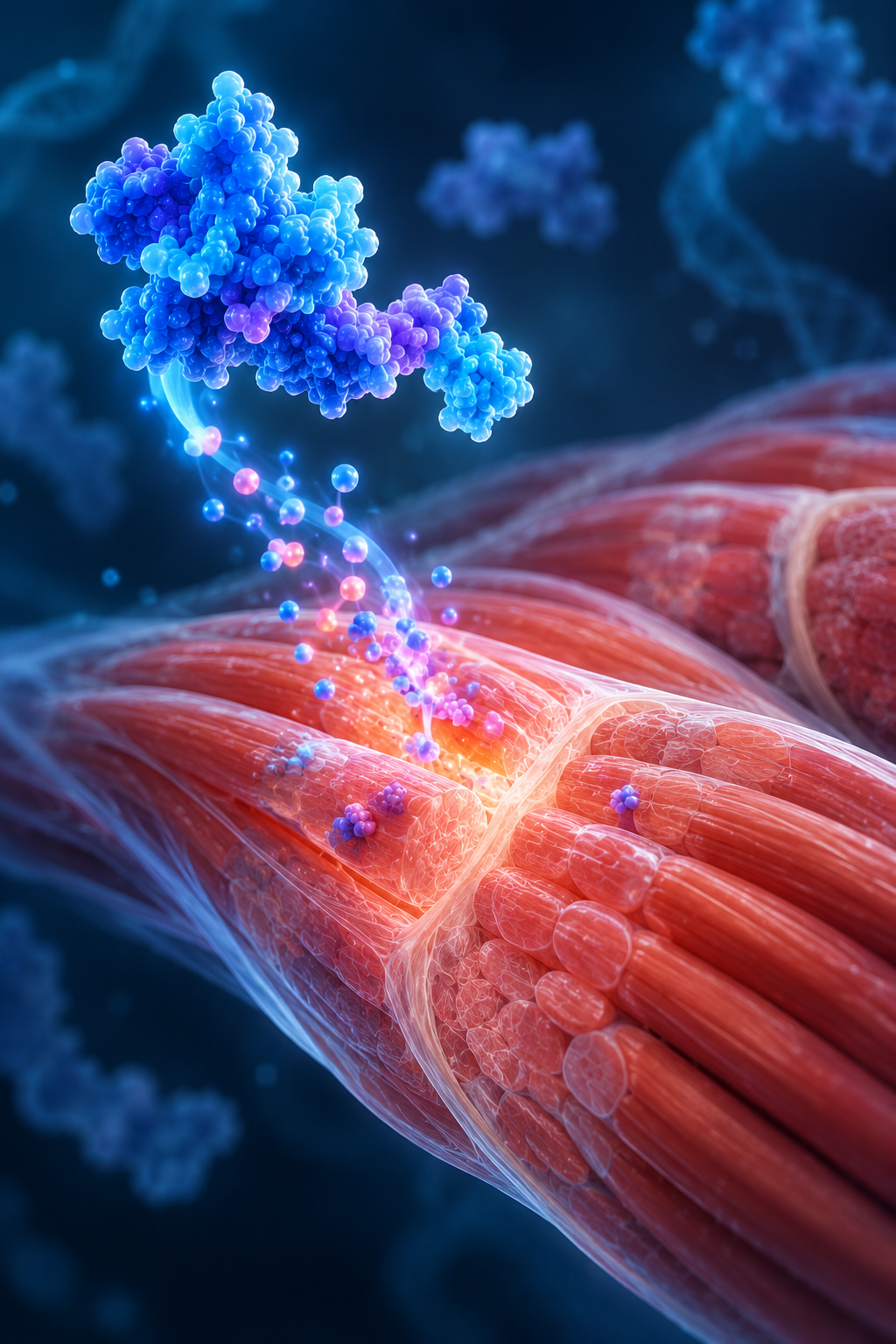
IGF-1 contributes to these processes by binding to specialized receptors on muscle cells, activating signaling pathways involved in cellular growth.
One important pathway is the PI3K–Akt–mTOR pathway, which helps regulate muscle protein synthesis and the development of muscle tissue.
IGF-1 signaling can also influence protein breakdown and the activity of satellite cells, specialized muscle-associated stem cells involved in muscle maintenance and repair.
Experimental studies suggest that IGF-1 can support satellite cell activation, proliferation, and differentiation under certain conditions.
Together, these mechanisms help explain why IGF-1 is an important subject of muscle growth research.
However, IGF-1 is only one component of muscle development. Resistance exercise, adequate nutrition, recovery, and other signaling pathways also contribute to muscle growth.
What Is the Relationship Between Growth Hormone and IGF-1?
Growth hormone and IGF-1 work together through a biological system known as the GH–IGF-1 axis.
Growth hormone is released by the pituitary gland and stimulates IGF-1 production, particularly in the liver.
IGF-1 then participates in regulating growth and tissue-related processes throughout the body.
However, skeletal muscle can also produce IGF-1 locally, allowing it to influence nearby cells independently of circulating IGF-1 levels.
This distinction is important because higher IGF-1 levels in the bloodstream do not necessarily indicate greater IGF-1 activity within muscle tissue.
Although closely connected, growth hormone and IGF-1 have different biological functions, and their effects on muscle growth are not interchangeable.
Current Research Limitations
Although IGF-1 plays an established role in normal growth and muscle biology, several important limitations remain when interpreting its relationship with muscle development.
Much of the research examining IGF-1's direct effects on muscle growth comes from laboratory experiments and animal studies.
These investigations have identified important mechanisms involving protein synthesis, satellite cell activity, and cellular growth signaling. However, findings from experimental models do not always translate directly to human muscle growth.
Human studies have also shown that increases in circulating IGF-1 do not consistently predict greater muscle size or strength following resistance training.
Muscle hypertrophy involves multiple biological processes, including mechanical tension, nutrition, recovery, and signaling pathways that can operate independently of IGF-1.
Additionally, IGF-1 influences cellular growth throughout the body, not exclusively within skeletal muscle. Excessive IGF-1 activity may contribute to unwanted biological effects, making safety an important consideration.
Current evidence does not establish that artificially increasing IGF-1 levels reliably improves muscle growth in otherwise healthy individuals.
Further human research is necessary to better understand how circulating and locally produced IGF-1 contribute to muscle adaptation, and how these mechanisms interact with exercise and other physiological factors.
Conclusion
IGF-1 is an important growth-related hormone involved in skeletal muscle development, cellular signaling, and tissue maintenance.
Research has identified several mechanisms through which IGF-1 influences muscle biology, including activation of the PI3K–Akt–mTOR pathway, regulation of protein metabolism, and interactions with muscle satellite cells.
Its close relationship with growth hormone also makes IGF-1 an important component of the biological systems responsible for growth and tissue development.
However, IGF-1 is only one part of the complex process responsible for muscle growth.
Although experimental research demonstrates its involvement in muscle-related signaling, current human evidence does not establish that simply increasing IGF-1 levels reliably produces greater muscle size or strength in healthy individuals.
Understanding IGF-1's role in muscle growth requires distinguishing its established biological functions from claims about enhancing muscle development.
As research continues, scientists may gain a clearer understanding of how IGF-1 interacts with exercise, nutrition, and other cellular pathways involved in muscle adaptation.
At Peptide Purity USA, we emphasize research material quality, analytical transparency, and responsible laboratory practices to support scientific investigation.
Research Use Only: All research materials offered by Peptide Purity USA are intended strictly for laboratory research purposes. Not for human or veterinary consumption. Not intended for diagnostic or therapeutic applications.
References
- 1. Yoshida, T., Delafontaine, P. (2020). Mechanisms of IGF-1-Mediated Regulation of Skeletal Muscle Hypertrophy and Atrophy. Cells, 9(9), 1970.
- https://doi.org/10.3390/cells9091970
- 2. Bodine, S. C., et al. (2001). Akt/mTOR Pathway Is a Crucial Regulator of Skeletal Muscle Hypertrophy and Can Prevent Muscle Atrophy In Vivo. Nature Cell Biology, 3, 1014–1019.
- https://doi.org/10.1038/ncb1101-1014
- 3. Molecular Mechanisms of Skeletal Muscle Hypertrophy. (2021). Journal of Applied Physiology and related molecular muscle research literature.
- https://pmc.ncbi.nlm.nih.gov/articles/PMC8075408/
- 4. West, D. W. D., Phillips, S. M. (2012). Associations of Exercise-Induced Hormone Profiles and Gains in Strength and Hypertrophy in a Large Cohort After Weight Training. European Journal of Applied Physiology, 112, 2693–2702.
- https://doi.org/10.1007/s00421-011-2246-z
- 5. Regulation of Muscle Hypertrophy: Involvement of the Akt-Independent Pathway and Satellite Cells in Muscle Hypertrophy. (2021).
- https://pubmed.ncbi.nlm.nih.gov/34793776/