Introduction
Have you ever wondered why research peptides typically arrive as a dry powder rather than a liquid?
The reason has a lot to do with stability.
Peptides are chains of amino acids, and some can be sensitive to moisture, temperature, and chemical reactions that gradually alter their molecular structure.
When certain peptides are stored in liquid form, these reactions can occur more readily, potentially affecting their purity and biological activity.
To help protect these sensitive compounds, manufacturers often use a process called lyophilization, better known as freeze-drying.
By removing water under carefully controlled conditions, freeze-drying can help slow degradation and improve the stability of peptides during storage and transportation.
But why does removing water help preserve a peptide, and what actually happens during freeze-drying?
Understanding this process explains why so many research peptides are supplied as lyophilized powders instead of ready-made solutions.
Research Background
What Is Lyophilization?
Lyophilization, commonly known as freeze-drying, is a process used to remove water from sensitive materials while helping preserve their chemical structure and stability.
Unlike traditional drying methods that rely heavily on heat, freeze-drying uses extremely low temperatures and reduced pressure to remove moisture without exposing the material to excessive heat.
The process relies on a scientific principle called sublimation, which occurs when frozen water changes directly from ice into vapor without passing through the liquid state.
For research peptides, lyophilization generally involves three stages:
1. Freezing
The peptide solution is cooled until the water freezes, preparing the material for controlled moisture removal.
2. Primary Drying
The surrounding pressure is reduced, and carefully controlled heat is applied, allowing frozen water to escape as vapor through sublimation.
This stage removes most of the ice from the formulation.
3. Secondary Drying
Additional moisture is removed through a process called desorption, reducing the amount of water remaining in the dried material.
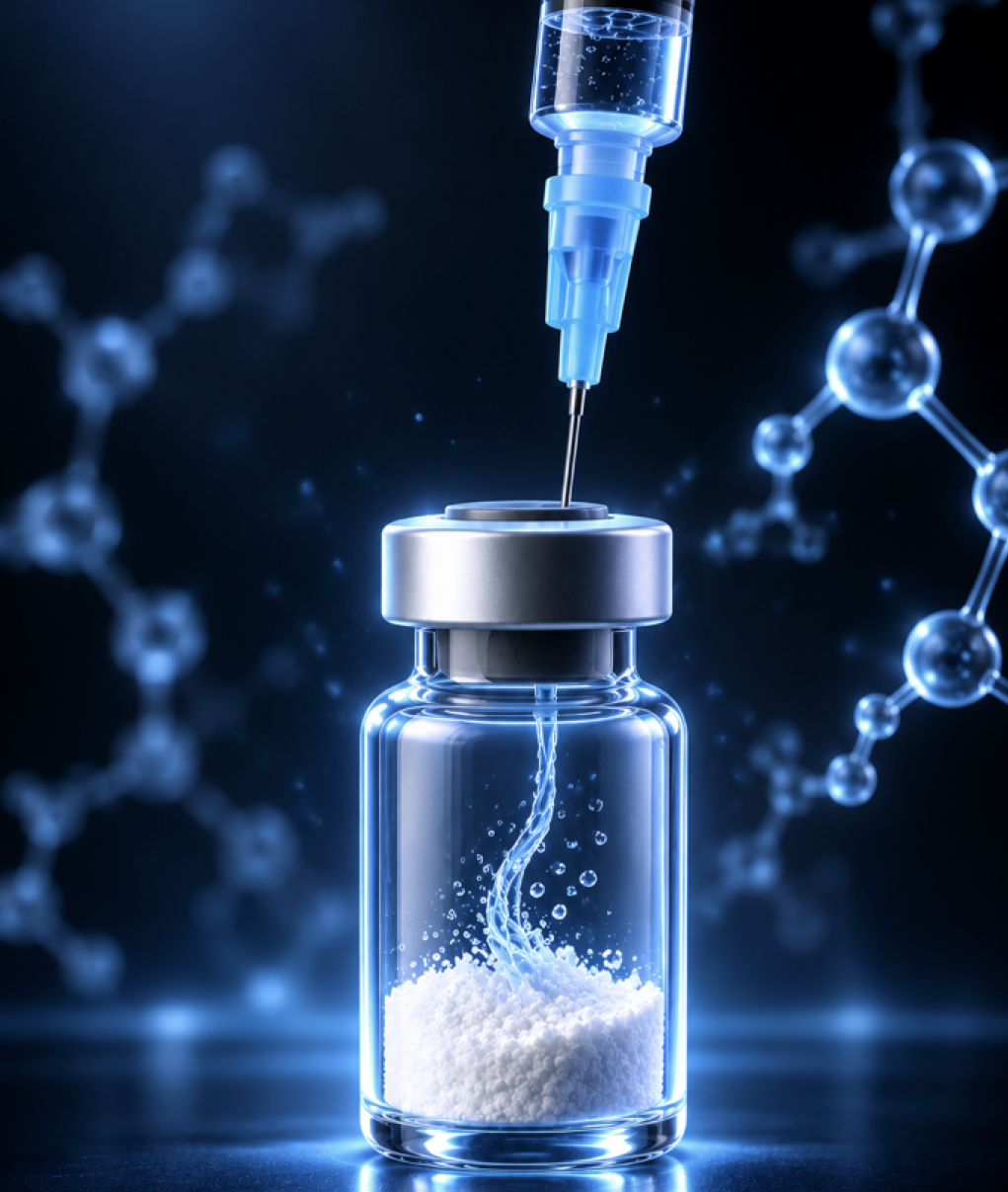
Once complete, the peptide formulation typically appears as a lightweight, porous cake or powder inside a laboratory vial.
The result is a dry peptide formulation that may remain more chemically stable during storage than the same peptide dissolved in water.
However, the effectiveness of lyophilization depends on the peptide's molecular properties and how carefully the freezing and drying conditions are controlled.
Main Research Findings
Why Are Peptides Freeze-Dried?
The main reason peptides are freeze-dried is to help preserve their chemical stability.
Water plays an important role in many chemical reactions, and removing it can help protect sensitive peptide molecules from certain forms of degradation.
However, the benefits of lyophilization extend beyond simply keeping peptides dry.
1. Improved Chemical Stability and Molecular Integrity
One of the greatest challenges in peptide storage is preventing chemical changes that could affect a molecule's structure and biological properties.
When peptides are dissolved in water, certain degradation reactions can occur more readily, depending on their amino acid sequence and surrounding conditions.
These reactions may include hydrolysis, deamidation, and oxidation, potentially altering how a peptide interacts with other molecules or behaves during laboratory experiments.
Freeze-drying can help reduce certain degradation pathways by removing water and limiting molecular movement, helping preserve peptide integrity over time.
This is particularly important in scientific research, where changes in material composition can affect experimental consistency and reproducibility.
However, lyophilization does not eliminate every form of degradation. Freezing and drying can also introduce stresses, making carefully controlled processing conditions essential.
2. Longer Storage Stability
Many peptides can maintain their chemical integrity longer in a properly formulated, freeze-dried state than in a liquid solution.
By reducing moisture content, lyophilization can slow reactions that would otherwise gradually change the peptide's structure during storage.
This is particularly valuable for research materials that may need to be stored for extended periods before laboratory analysis.
However, freeze-dried does not mean a peptide will remain stable indefinitely.
Actual shelf life depends on the peptide's molecular structure, formulation, packaging, and storage temperature.
Some lyophilized peptides still require refrigeration or frozen storage to maintain their stability.
3. Greater Stability During Transportation
Transporting research peptides can expose them to changing temperatures and environmental conditions.
For certain peptides, these fluctuations may accelerate degradation, particularly when the compounds are stored in liquid form.
Lyophilization can make some peptide formulations less vulnerable to moisture-dependent reactions during shipping, helping preserve their chemical integrity between manufacturing and laboratory use.
This is one reason freeze-drying is widely used in the preparation of sensitive pharmaceutical and research materials.
However, freeze-dried peptides are not automatically resistant to heat, and appropriate shipping conditions remain important.
4. Preparation for Laboratory Reconstitution
Another advantage of freeze-drying is that peptides can be stored as dry materials until they are needed for laboratory experiments.
When required, a lyophilized peptide can be dissolved in an appropriate solvent through a process known as reconstitution.
This allows researchers to prepare peptide solutions for specific analytical or experimental applications.
However, once a peptide is dissolved, its stability characteristics may change.
A peptide that remains stable for an extended period in its dry form may degrade more rapidly after reconstitution, depending on the compound and solution conditions.
Factors such as temperature, pH, solvent composition, and peptide concentration can all influence how long a reconstituted solution remains chemically stable.
This distinction is important because the shelf life of a freeze-dried peptide does not necessarily reflect its stability after being dissolved.
Conclusion
Freeze-drying plays an important role in peptide research by helping protect sensitive compounds from chemical degradation during storage and transportation.
Through lyophilization, water is removed under carefully controlled conditions, reducing the likelihood of certain chemical reactions that can alter a peptide's molecular structure.
For many research peptides, this can mean improved storage stability, greater flexibility in laboratory preparation, and better preservation of chemical integrity over time.
However, freeze-dried does not mean a peptide is permanently stable or immune to environmental conditions.
Temperature, moisture, packaging, and the peptide's molecular properties all influence how well a lyophilized formulation maintains its stability.
The key takeaway: Peptides are commonly freeze-dried because removing water can slow degradation and help preserve their chemical integrity until they are needed for laboratory research.
At Peptide Purity USA, we emphasize research material quality, analytical transparency, and responsible laboratory practices to support scientific investigation.
Research Use Only: All research materials offered by Peptide Purity USA are intended strictly for laboratory research purposes. Not for human or veterinary consumption. Not intended for diagnostic or therapeutic applications.
References
- 1. Wang, W. (2000). Lyophilization and development of solid protein pharmaceuticals. International Journal of Pharmaceutics, 203(1–2), 1–60.
- 2. Tang, X., & Pikal, M. J. (2004). Design of freeze-drying processes for pharmaceuticals: Practical advice. Pharmaceutical Research, 21(2), 191–200.
- 3. Chang, L. L., & Pikal, M. J. (2009). Mechanisms of protein stabilization in the solid state. Journal of Pharmaceutical Sciences, 98(9), 2886–2908.
- 4. Manning, M. C., Chou, D. K., Murphy, B. M., Payne, R. W., & Katayama, D. S. (2010). Stability of protein pharmaceuticals: An update. Pharmaceutical Research, 27(4), 544–575.
- 5. Bhatnagar, B. S., Bogner, R. H., & Pikal, M. J. (2007). Protein stability during freezing: Separation of stresses and mechanisms of protein stabilization. Pharmaceutical Development and Technology, 12(5), 505–523.