Introduction
Have you ever wondered why research peptides typically arrive as a dry powder rather than a ready-to-use liquid?
The reason comes down to one important factor: stability.
Many research peptides are supplied as a freeze-dried powder, known as a lyophilized peptide. Removing water helps slow certain chemical reactions that can cause peptides to degrade, making this form useful for storage and transportation.
But what happens when a laboratory experiment requires the peptide in liquid form?
That's where peptide reconstitution comes in.
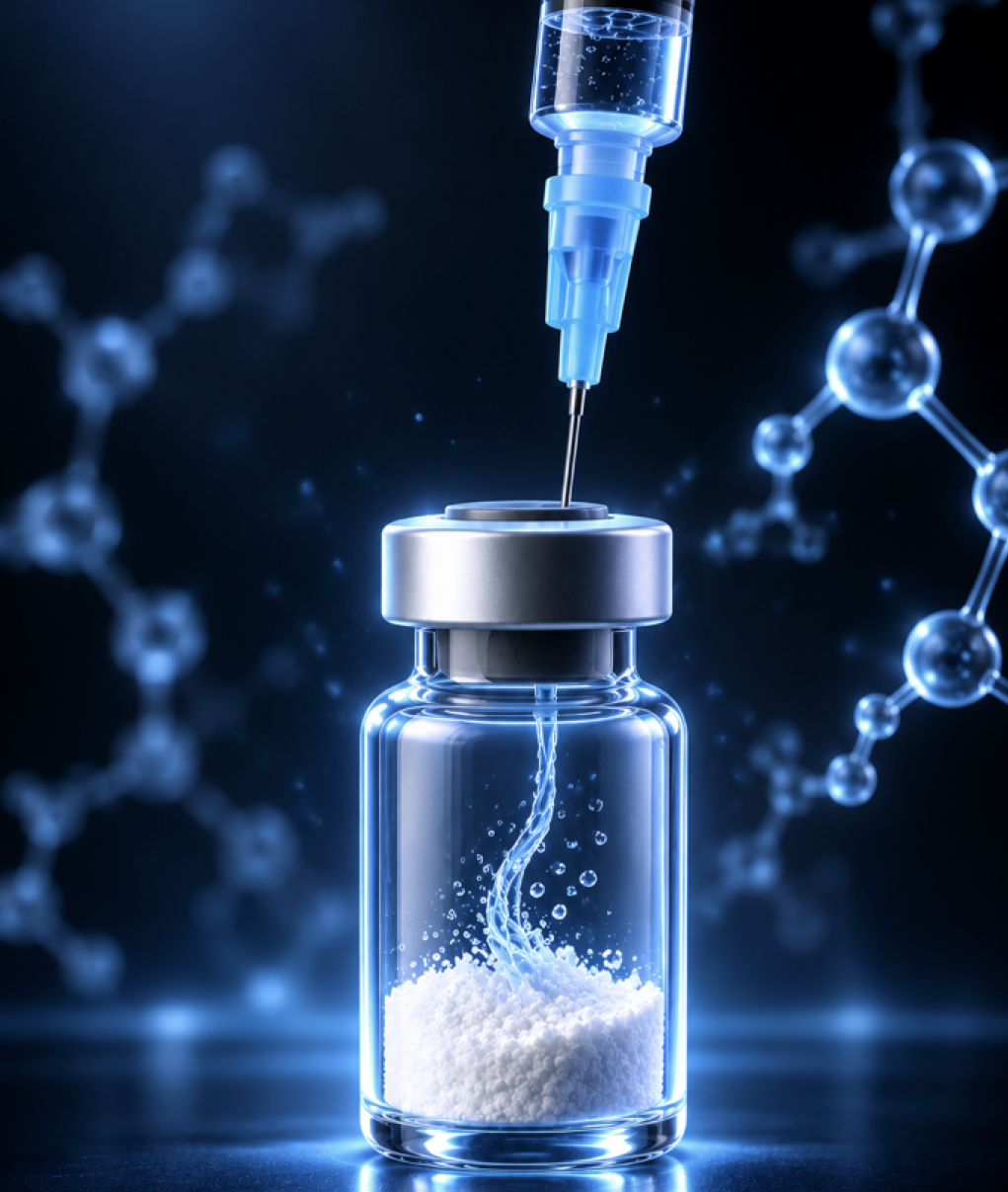
Peptide reconstitution is the process of dissolving a lyophilized peptide in a suitable solvent to prepare it for laboratory research.
While adding liquid to a vial may sound simple, the process requires careful consideration. The type of solvent, peptide concentration, temperature, and handling conditions can all affect how well a peptide dissolves and how stable it remains afterward.
Using unsuitable conditions can lead to incomplete dissolution, peptide aggregation, or chemical degradation, potentially affecting the accuracy of research results.
So, how does peptide reconstitution work, and what should researchers consider when preparing peptides for laboratory use?
This guide explains the science behind peptide reconstitution, the factors that influence peptide stability, and the laboratory best practices that help maintain sample integrity and produce reliable research results.
Research Background
What Is Peptide Reconstitution?
Peptide reconstitution is the process of dissolving a dried peptide in a compatible solvent to create a liquid solution for laboratory research.
As discussed earlier, many research peptides undergo lyophilization (freeze-drying) to help preserve their stability during storage and transportation.
This process removes water under controlled conditions, reducing certain chemical reactions that can cause peptides to degrade.
However, freeze-drying does not make peptides permanently stable. Their long-term integrity still depends on factors such as molecular structure, residual moisture, formulation, and storage conditions.
When an experiment requires a peptide in liquid form, researchers must select reconstitution conditions appropriate for that particular compound.
What Happens During Reconstitution?
When a suitable solvent is added to a lyophilized peptide, the solvent interacts with the peptide molecules, allowing them to dissolve and disperse throughout the liquid.
How easily this happens depends largely on the peptide's amino acid sequence and chemical properties.
Some amino acids interact readily with water, while others are hydrophobic, meaning they tend to avoid interactions with water.
Peptides containing more hydrophobic regions may be difficult to dissolve in water alone.
Other peptides may require specific pH conditions or specialized solvent systems to achieve adequate solubility.
Even when a peptide dissolves, unsuitable conditions can sometimes cause the molecules to aggregate, precipitate, or undergo chemical degradation.
Not all peptides dissolve the same way, which is why there is no universal reconstitution method suitable for every research peptide.
Understanding these differences helps researchers select preparation conditions that support peptide solubility and stability.
Reconstitution vs. Dilution: What's the Difference?
Although reconstitution and dilution are closely related, they serve different purposes in laboratory research.
Reconstitution involves adding a suitable solvent to a dried peptide to create a liquid solution.
Dilution involves adding more solvent to an existing solution to reduce its concentration.
For example, a researcher might reconstitute a lyophilized peptide to prepare a concentrated stock solution.
That stock solution can then be diluted to obtain the lower concentrations required for specific laboratory experiments.
The key distinction is simple:
Reconstitution: Converts a dried peptide preparation into a liquid solution.
Dilution: Reduces the concentration of a solution that has already been prepared.
Both processes are important for accurate concentration calculations, consistent sample preparation, and reproducible research results.
Main Research Findings
1. Choosing the Right Solvent for Peptide Reconstitution
Choosing the correct solvent is one of the most important steps in peptide reconstitution.
Different peptides have different chemical properties, meaning a solvent that works well for one compound may not be suitable for another.
The best choice depends on several factors, including the peptide's amino acid sequence, molecular charge, solubility, and intended laboratory application.
Common solvent options used in peptide research include:
Purified Water
Highly purified laboratory water is commonly used to reconstitute peptides that dissolve readily in aqueous solutions.
Water quality is important because impurities, dissolved minerals, and trace metals can potentially affect peptide stability or interfere with laboratory measurements.
Laboratory Buffers
Buffered solutions help maintain a consistent pH, which can influence how easily a peptide dissolves and how stable it remains.
Some peptides are more soluble under particular pH conditions, making buffer selection an important consideration.
However, researchers must also ensure that buffer components are compatible with the intended experiment.
Specialized Solvent Systems
Certain peptides are difficult to dissolve in water because of their molecular structure.
In these cases, researchers may use carefully selected acidic, alkaline, or organic solvent systems to improve solubility.
These approaches require additional consideration because solvent composition can influence peptide stability and interfere with certain laboratory assays.
There is no single solvent that works for every peptide. The appropriate choice depends on the compound's chemical properties and the requirements of the research being conducted.
2. Bacteriostatic Water vs. Sterile Water
Two terms frequently encountered in peptide reconstitution discussions are bacteriostatic water and sterile water.
Although both are used in pharmaceutical preparation, they are not interchangeable in every application.
Bacteriostatic Water
Bacteriostatic Water for Injection is a sterile pharmaceutical preparation that typically contains 0.9% benzyl alcohol as a preservative.
Benzyl alcohol helps inhibit the growth of certain bacteria, but it does not eliminate all microorganisms or guarantee that a preparation will remain free from contamination.
The preservative can also affect the stability or compatibility of certain compounds.
Sterile Water
Sterile Water for Injection is a sterile preparation that does not contain added antimicrobial preservatives.
Because it lacks a preservative, it does not provide the same antimicrobial protection as bacteriostatic water.
However, the absence of benzyl alcohol may be important when working with compounds or analytical methods that are sensitive to preservatives.
Which Is Better for Peptide Reconstitution?
Neither option is universally better.
The appropriate solvent depends on the peptide's chemical properties, formulation requirements, and intended application.
For analytical laboratory work, researchers may instead use highly purified laboratory water or validated buffer systems.
Importantly, using bacteriostatic or sterile water does not make a research peptide sterile, safe for injection, or suitable for human use.
Research peptides should be handled according to their intended laboratory applications and established experimental protocols.
3. Understanding Peptide Concentration
Once a peptide has been reconstituted, its concentration becomes an important factor in laboratory research.
Concentration describes how much peptide is present in a given volume of solution.
Accurate concentration measurements help researchers prepare consistent samples, compare experimental results, and reduce variability between studies.
The basic formula is:
Peptide Concentration = Amount of Peptide ÷ Final Solution Volume
For example, consider a laboratory sample containing 10 mg of peptide in a final solution volume of 2 mL.
10 mg ÷ 2 mL = 5 mg/mL
The resulting nominal concentration is 5 milligrams of peptide per milliliter of solution.
However, there is an important distinction between the total weight of a lyophilized powder and the amount of peptide it contains.
Some preparations include residual moisture, counterions, salts, or other formulation components.
This means the total powder weight may not accurately represent the amount of peptide available for research.
For experiments requiring precise measurements, researchers should review available analytical documentation and account for peptide content when calculating concentrations.
4. Why Proper Handling Matters
Peptides can be sensitive to the conditions they encounter during preparation.
Factors such as temperature, mixing intensity, container materials, and exposure to air can influence the stability of certain peptide solutions.
For example, vigorous shaking may promote aggregation in some sensitive formulations, particularly when repeated mixing increases exposure to air–liquid interfaces.
Aggregation occurs when peptide molecules associate with one another, potentially changing their behavior in solution.
However, not all peptides respond the same way.
Some tolerate mixing without significant changes, while others require more controlled preparation conditions.
Gentle handling can help reduce unnecessary physical stress, but preparation methods should always be appropriate for the specific peptide.
Container selection also matters.
Certain peptides can adhere to glass or plastic surfaces, a process known as adsorption.
When this occurs, some peptide molecules may remain attached to the container rather than staying in solution.
This can reduce the measurable peptide concentration and affect experimental accuracy, especially when working with small quantities.
5. What Happens to Peptides After Reconstitution?
Reconstituting a peptide does not mean it will remain stable indefinitely.
Once dissolved, peptide molecules interact with water and other components of the solution, potentially making certain chemical reactions more likely.
Several processes can affect peptide stability over time:
Hydrolysis: The breakdown of susceptible chemical bonds through reactions involving water.
Oxidation: Chemical changes involving oxidation-sensitive amino acids.
Deamidation: Chemical modifications involving certain amino acid residues, particularly asparagine and glutamine.
Aggregation: Peptide molecules associating to form larger molecular structures.
Precipitation: Peptide material separating from the solution and forming insoluble particles.
The likelihood and rate of these changes depend on the peptide's molecular structure, solvent composition, pH, temperature, and storage conditions.
Some peptides remain stable in solution under validated conditions, while others may degrade more rapidly.
This is why researchers should not assume that every reconstituted peptide has the same shelf life.
It's also important to understand that appearance alone cannot confirm stability.
A peptide solution may look completely clear while still containing chemically degraded molecules or other impurities.
For research requiring high accuracy, analytical testing and compound-specific stability data provide a more reliable assessment of peptide integrity.
Research Methodology / Context
How Do Researchers Test Reconstituted Peptides?
Successfully dissolving a peptide is only part of the preparation process.
For laboratory research, it's also important to determine whether the resulting solution contains the expected peptide and meets the requirements of the intended experiment.
Researchers use several analytical techniques to evaluate peptide identity, purity, solubility, and stability.
These methods can help identify chemical changes, detect impurities, and determine whether a peptide remains suitable for a particular research application.
High-Performance Liquid Chromatography (HPLC)
High-performance liquid chromatography (HPLC) is one of the most widely used techniques for analyzing peptide purity.
The method separates components within a sample, allowing researchers to examine the peptide alongside certain impurities or degradation products.
By comparing HPLC results before and after reconstitution, researchers may be able to identify changes in the sample's chemical composition.
For example, the appearance of additional chromatographic peaks may indicate the formation of degradation products or other changes that require further investigation.
However, HPLC has limitations.
A high HPLC purity percentage does not automatically confirm peptide identity, sterility, or biological activity.
Additional testing may be necessary depending on the research application.
Mass Spectrometry (MS)
Mass spectrometry (MS) is used to measure the mass-to-charge ratios of ions, helping researchers confirm a peptide's molecular mass and investigate its identity.
This is particularly useful because peptides can have similar physical characteristics while differing in their molecular structures.
When combined with liquid chromatography, mass spectrometry can also help detect certain chemical modifications or degradation products.
For example, oxidation or other chemical reactions may produce measurable changes in molecular mass.
Together, HPLC and MS provide complementary information about peptide composition and identity.
Solubility and Aggregation Testing
Researchers may also examine how well a peptide remains dissolved after reconstitution.
Some peptides can form aggregates, which occur when individual peptide molecules associate into larger structures.
Depending on the compound and experimental requirements, researchers may use techniques such as:
Dynamic Light Scattering (DLS): Measures particle-size distributions in solution and can help detect certain aggregates.
Size-Exclusion Chromatography (SEC): Separates molecules according to their behavior in a size-based chromatographic system, helping researchers investigate soluble aggregates.
Visual Inspection: Identifies obvious cloudiness, precipitation, or visible particles.
Each method provides different information, and no single test can detect every possible form of peptide instability.
A clear solution does not necessarily mean a peptide is free from aggregation or chemical degradation.
Stability Studies
Stability testing helps researchers understand how a reconstituted peptide changes over time.
These studies evaluate peptide preparations under defined conditions, which may include differences in temperature, pH, light exposure, storage duration, and container materials.
Researchers analyze samples at selected intervals to determine whether the peptide's chemical composition or other relevant characteristics have changed.
For example, HPLC and mass spectrometry may be used to monitor degradation products, while other techniques can evaluate changes in aggregation or solution properties.
The results help establish appropriate handling conditions and evidence-based storage periods for specific peptide formulations.
Because peptides vary in their chemical properties, stability findings for one compound cannot automatically be applied to another.
Current Research Limitations
Although peptide reconstitution is a well-established laboratory procedure, there are important limitations to consider when interpreting preparation methods and stability data.
The main challenge is that peptides differ significantly in their chemical properties, making it difficult to establish universal reconstitution guidelines.
Different Peptides Require Different Conditions
Peptides vary in molecular structure, amino acid composition, charge, and solubility.
These differences influence how they interact with solvents and how stable they remain after reconstitution.
A preparation method that works well for one peptide may result in incomplete dissolution or chemical instability in another.
For this reason, researchers cannot assume that reconstitution methods validated for one compound will produce the same results with a different peptide.
Stability Data Do Not Apply Universally
Published peptide stability studies are typically conducted under specific experimental conditions.
Factors such as solvent composition, concentration, pH, temperature, and container materials can all influence the results.
Even two preparations containing the same peptide may behave differently if their formulations or storage conditions are not identical.
A reported stability period should only be applied to preparations that match the conditions supported by the available evidence.
Appearance Alone Cannot Confirm Peptide Quality
Visual inspection can help identify obvious problems, such as cloudiness, precipitation, or visible particles.
However, a solution that appears clear may still contain chemically degraded peptide molecules or impurities that cannot be seen.
Likewise, visible precipitation does not reveal the exact cause of instability.
When chemical integrity is important to an experiment, researchers need appropriate analytical testing rather than relying on appearance alone.
Reconstitution Cannot Improve the Quality of the Original Peptide
The quality of a reconstituted solution depends partly on the material used to prepare it.
If a peptide contains impurities or has already undergone chemical degradation, adding a solvent will not reverse those changes.
Reconstitution also does not establish peptide identity, remove contaminants, or guarantee sterility.
A Certificate of Analysis (COA) can provide useful information about a peptide's identity, purity, and other tested characteristics.
However, the value of a COA depends on the analytical methods performed, the results reported, and whether the testing applies to the specific material being evaluated.
The key takeaway is that successful peptide reconstitution does not automatically confirm purity, stability, sterility, or suitability for a particular research application.
Discussion
Common Peptide Reconstitution Mistakes
Even small mistakes during peptide reconstitution can affect solution quality and experimental accuracy.
Understanding these common errors can help researchers maintain more consistent preparation methods and avoid unnecessary variability.
1. Using the Wrong Solvent
Not every peptide dissolves readily in water, and some require specific solvent conditions.
Choosing an incompatible solvent may result in incomplete dissolution, precipitation, or chemical instability.
2. Following the Same Method for Every Peptide
Peptides have different chemical properties, meaning a preparation method suitable for one compound may not work for another.
Researchers should follow compound-specific preparation requirements rather than relying on a universal reconstitution method.
3. Confusing Powder Weight With Peptide Content
Lyophilized preparations may contain residual moisture, salts, or other formulation components.
Using the total powder weight without accounting for actual peptide content can lead to inaccurate concentration calculations.
4. Overlooking Solution pH
The pH of a solution can influence peptide solubility, molecular charge, and chemical stability.
Unsuitable pH conditions may cause certain peptides to precipitate or degrade.
5. Assuming a Clear Solution Means the Peptide Is Stable
A solution may appear completely clear even when chemical degradation has occurred.
Visual inspection is useful for identifying obvious changes, but it cannot replace appropriate analytical testing.
6. Ignoring Contamination Risks
Contaminants can enter a peptide preparation through solvents, laboratory equipment, containers, or handling procedures.
Using sterile or bacteriostatic water does not automatically make the final preparation sterile or free from contamination.
7. Failing to Document Preparation Conditions
Accurate laboratory records are essential for reproducible research.
Researchers should document relevant details such as solvent composition, peptide concentration, preparation date, and storage conditions.
Consistent documentation makes it easier to identify potential sources of experimental variation.
Peptide Storage After Reconstitution
Storage conditions become especially important once a peptide has been dissolved.
While lyophilization helps reduce certain degradation reactions by removing water, reconstitution introduces the peptide into a liquid environment where chemical changes may occur more readily.
The rate of degradation depends on the peptide's molecular structure, solvent composition, concentration, temperature, and other environmental factors.
Some peptide solutions remain stable for extended periods under validated conditions, while others may degrade more quickly.
There is no universal storage temperature or shelf life that applies to every reconstituted peptide.
Researchers should rely on compound-specific stability information rather than assuming that all peptide solutions can be stored under the same conditions.
It's also important to distinguish between chemical stability and microbial contamination.
A peptide may remain chemically intact while becoming contaminated, depending on how the preparation is handled and stored.
For a more detailed explanation of peptide storage conditions, see our guide: Peptide Storage Guide: Temperature, Stability & Laboratory Best Practices.
Why Proper Reconstitution Matters for Research Accuracy
Reliable scientific research depends on consistency.
If peptide concentration, solvent composition, or preparation conditions vary between experiments, the results may become difficult to compare.
For example, an observed biological response could be influenced by differences in actual peptide concentration, the presence of degradation products, or the effects of certain solvent components.
These variables can make it harder to determine whether an experimental result is caused by the peptide itself or by differences in sample preparation.
Careful reconstitution, appropriate analytical testing, and consistent documentation help researchers reduce these uncertainties.
Ultimately, proper peptide reconstitution is about more than dissolving a powder. It's about preparing a consistent, well-characterized solution that supports accurate and reproducible laboratory research.
Conclusion
Peptide reconstitution is an important part of laboratory research, allowing lyophilized peptides to be prepared as liquid solutions for experimental use.
While the process may seem as simple as adding a solvent to a dried powder, several factors can influence the quality and stability of the resulting solution.
Solvent compatibility, peptide concentration, pH, handling techniques, and storage conditions all play important roles in successful reconstitution.
Because peptides differ in their molecular structure and chemical properties, there is no single preparation method that works for every compound.
Researchers must also recognize that dissolving a peptide does not automatically confirm its purity, stability, or suitability for a particular experiment.
Analytical techniques such as HPLC and mass spectrometry can help evaluate peptide identity and chemical integrity, while stability testing provides valuable information about how preparations change over time.
The key takeaway is that proper peptide reconstitution requires more than dissolving a powder. It requires an understanding of the individual peptide and careful attention to the conditions that influence its stability and experimental accuracy.
By following validated preparation methods and maintaining consistent laboratory practices, researchers can reduce unnecessary variability and produce more reliable scientific results.
At Peptide Purity USA, we emphasize research material quality, analytical transparency, and responsible laboratory practices to support scientific investigation.
Research Use Only: All research materials offered by Peptide Purity USA are intended strictly for laboratory research purposes. Not for human or veterinary consumption. Not intended for diagnostic or therapeutic applications.
References
- 1. Designing Formulation Strategies for Enhanced Stability of Therapeutic Peptides in Aqueous Solutions: A Review (2023).
- 2, Regulatory Guidelines for the Analysis of Therapeutic Peptides and Proteins (2025).
- 3. ICH Q5C: Stability Testing of Biotechnological/Biological Products.