
Introduction
Could compounds originally developed to regulate blood sugar and appetite also influence the desire to drink alcohol?
GLP-1–based medications have attracted significant attention for their effects on appetite regulation, weight management, and metabolic health.
But researchers are now exploring another intriguing possibility: their potential influence on alcohol cravings and drinking behavior.
Some individuals receiving GLP-1–based medications have reported reduced interest in alcohol, fewer cravings, or changes in their drinking habits.
These observations, alongside emerging scientific findings, have increased interest in compounds such as:
Semaglutide: A GLP-1 receptor agonist.
Tirzepatide: A dual GIP/GLP-1 receptor agonist.
Retatrutide: An investigational triple GIP/GLP-1/glucagon receptor agonist.
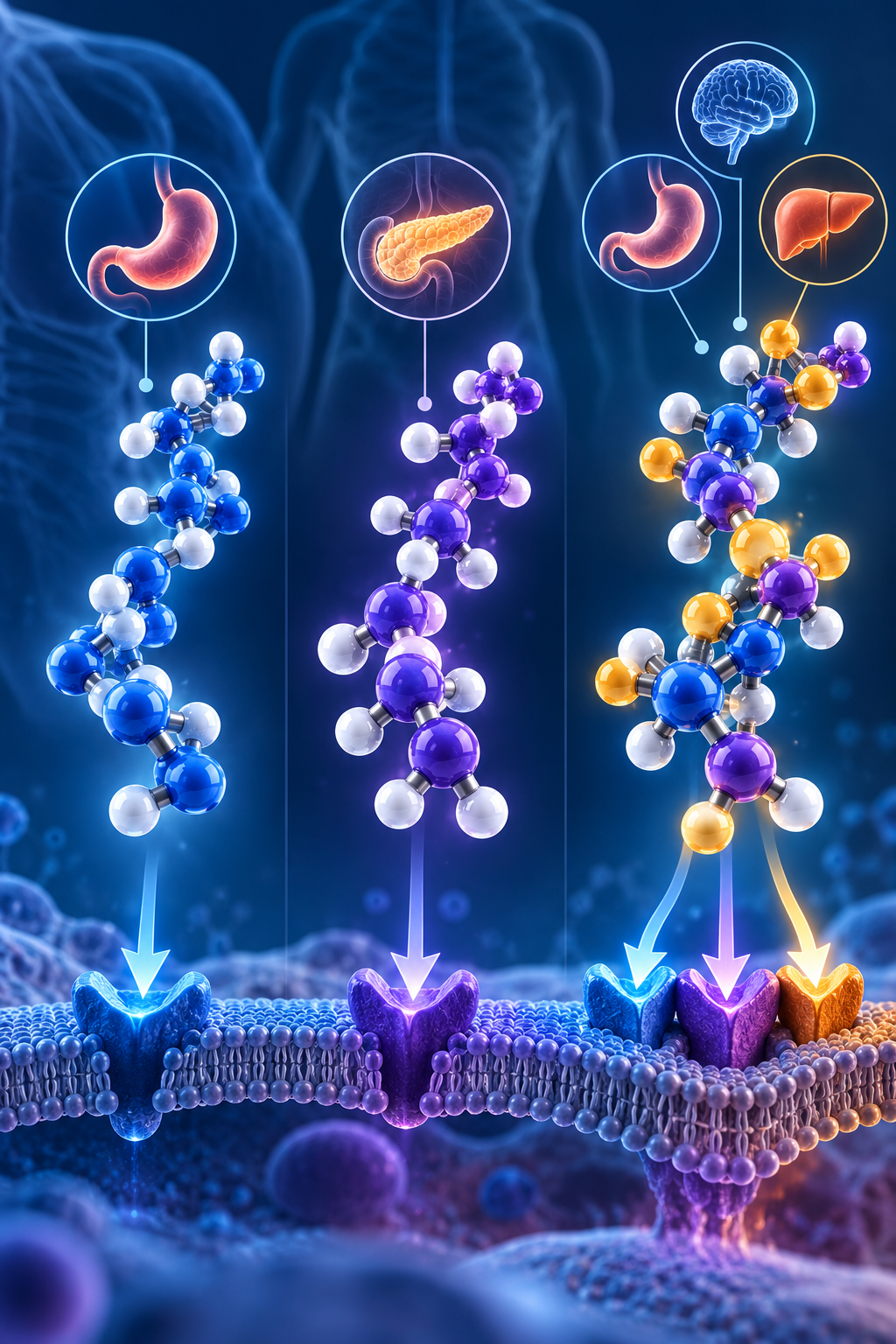
Although these compounds activate different combinations of metabolic hormone receptors, they share one important characteristic: GLP-1 receptor activation.
This raises an important scientific question:
Could GLP-1–based compounds influence the brain's reward pathways in ways that affect both food cravings and alcohol consumption?
Emerging research suggests that GLP-1 signaling may extend beyond hunger and satiety, potentially influencing neural pathways involved in motivation, reward processing, and substance-related behaviors.
However, the scientific evidence varies considerably between compounds. Early human clinical findings involving semaglutide are encouraging, while the alcohol-related effects of newer dual- and triple-receptor agonists remain less established.
Understanding these differences is essential as researchers continue investigating the relationship between GLP-1 signaling and alcohol-related behavior.
Main Research Findings
How Could GLP-1 Influence Alcohol Cravings?
GLP-1, or glucagon-like peptide-1, is a hormone best known for its role in blood sugar regulation, insulin secretion, and appetite control.
However, GLP-1 receptors are also present in areas of the brain involved in motivation, reward processing, and behavioral regulation.
These include neural circuits associated with dopamine signaling, a system that helps regulate how the brain responds to rewarding experiences.
Alcohol can influence these reward pathways, contributing to the reinforcing effects that may encourage repeated consumption.
Researchers are investigating whether GLP-1 receptor activation may alter reward-related signaling and reduce the motivation to consume alcohol.
Preclinical studies involving GLP-1 receptor agonists have reported reductions in alcohol intake and certain alcohol-related reward behaviors in animal models.
These findings suggest that GLP-1 signaling may influence more than hunger and satiety, potentially affecting how the brain processes rewarding substances.
However, the precise mechanisms remain under investigation, and results involving one GLP-1–based compound cannot automatically be applied to others.
What Does Research Show About Semaglutide, Tirzepatide, and Retatrutide?
Although semaglutide, tirzepatide, and retatrutide all activate GLP-1 receptors, the strength of scientific evidence regarding alcohol cravings differs considerably between them.
Semaglutide
Semaglutide has received direct clinical investigation for its potential effects on alcohol consumption and craving.
A randomized clinical trial published in 2025 evaluated semaglutide in adults with alcohol use disorder.
Researchers observed reductions in laboratory-measured alcohol consumption and certain measures of alcohol craving compared with placebo.
These findings provide preliminary clinical evidence that GLP-1 receptor activation may influence alcohol-related behavior.
However, not all drinking-related outcomes improved significantly, and larger clinical trials are necessary to establish its effectiveness and long-term safety for this purpose.
Tirzepatide
Tirzepatide activates both GIP and GLP-1 receptors, combining two metabolic hormone signaling pathways.
Observational research published in 2023 reported lower self-reported alcohol consumption among surveyed individuals receiving semaglutide or tirzepatide.
These findings suggest that dual-receptor agonists may also be relevant to alcohol-related research.
However, observational studies cannot establish cause and effect, and controlled clinical evidence specifically demonstrating that tirzepatide reduces alcohol cravings remains limited.
Further investigation is needed to determine whether its combined GIP/GLP-1 activity influences alcohol-related behavior differently from GLP-1 receptor activation alone.
Retatrutide
Retatrutide is an investigational triple-receptor agonist that activates GLP-1, GIP, and glucagon receptors.
Its unique mechanism has generated scientific interest in metabolic regulation, appetite control, and energy balance.
Because retatrutide includes GLP-1 receptor activity, its potential relationship with reward-related signaling represents an interesting area for future investigation.
However, clinical evidence demonstrating that retatrutide reduces alcohol cravings or consumption has not been established.
Its potential alcohol-related effects therefore remain hypothetical and should not be interpreted as demonstrated benefits.
Overall, emerging evidence supports investigating GLP-1 signaling in alcohol-related behavior, but it does not establish that semaglutide, tirzepatide, and retatrutide produce equivalent effects.
Is This Similar to the Reduction in Food Noise?
One reason this research has attracted attention is the potential connection between food cravings and alcohol cravings.
Both involve brain systems associated with reward, motivation, anticipation, and learned behaviors.
Some individuals receiving GLP-1–based medications report experiencing fewer persistent thoughts about food, a phenomenon commonly described as reduced "food noise."
Researchers are exploring whether similar changes in reward-related signaling could help explain reports of reduced interest in alcohol.
However, food cravings and alcohol cravings are not identical biological processes.
Alcohol-related behaviors can involve additional factors, including physical dependence, withdrawal, environmental influences, and complex neurological adaptations.
Therefore, a reduction in food-related thoughts does not necessarily mean that GLP-1–based medications will produce the same effect on alcohol cravings.
Nevertheless, the possibility that metabolic hormones influence overlapping reward-related pathways provides an important direction for continued scientific investigation.
Current Research Limitations
Despite growing scientific interest, several important limitations remain in understanding how GLP-1–based compounds influence alcohol cravings and drinking behavior.
Much of the available evidence comes from animal experiments, observational studies, and relatively small human clinical trials.
Although early clinical findings involving semaglutide are encouraging, research on alcohol-related outcomes remains considerably more limited for dual-receptor agonists such as tirzepatide and triple-receptor agonists such as retatrutide.
Researchers have not established whether activating additional receptors, including GIP or glucagon receptors, enhances, reduces, or otherwise changes potential effects on alcohol-related behavior.
Another important question is whether reported reductions in alcohol consumption result primarily from changes in brain reward signaling or from indirect effects such as nausea, reduced appetite, or broader behavioral changes.
These possibilities are not mutually exclusive, and further research is needed to clarify the underlying mechanisms.
Importantly, GLP-1–based medications are not currently FDA-approved specifically for treating alcohol use disorder.
Alcohol dependence can also involve potentially dangerous withdrawal symptoms, meaning that experimental findings should not be interpreted as a replacement for established medical treatment.
Larger, well-controlled clinical trials are necessary to determine whether these compounds can safely and consistently reduce alcohol cravings, how long any effects persist, and whether different receptor combinations produce meaningful differences in outcomes.
Conclusion
GLP-1–based compounds represent an expanding area of scientific research extending beyond metabolism and appetite regulation into the study of brain reward pathways and alcohol-related behavior.
Emerging evidence suggests that GLP-1 receptor activation may influence neural processes associated with motivation, alcohol consumption, and craving.
Early clinical findings involving semaglutide have demonstrated encouraging results, while observational research involving tirzepatide suggests potential effects that require further investigation. The alcohol-related effects of triple-receptor agonists such as retatrutide remain largely unexplored.
These differences highlight the importance of evaluating each compound according to its specific receptor activity and the strength of available scientific evidence.
Although GLP-1 signaling represents a promising area of alcohol-related research, current findings do not establish GLP-1–based medications as proven treatments for alcohol use disorder.
Further clinical investigations will be essential to determine whether these effects are consistent, how different receptor combinations influence reward-related behavior, and whether the findings translate into meaningful clinical outcomes.
At Peptide Purity USA, we emphasize scientifically grounded education, analytical transparency, and responsible laboratory research.
Research Use Only: All research materials offered by Peptide Purity USA are intended strictly for laboratory research purposes. Not for human or veterinary consumption. Not intended for diagnostic or therapeutic applications.
References
- 1. Hendershot, C. S., et al. (2025). Once-Weekly Semaglutide in Adults With Alcohol Use Disorder: A Randomized Clinical Trial. JAMA Psychiatry, 82(4), 395–405. https://doi.org/10.1001/jamapsychiatry.2024.4789
- 2. Quddos, F., et al. (2023). Semaglutide and Tirzepatide Reduce Alcohol Consumption in Individuals With Obesity. Scientific Reports, 13, 20998. https://doi.org/10.1038/s41598-023-48267-2
- 3. Wang, W., et al. (2024). Associations of Semaglutide With Incidence and Recurrence of Alcohol Use Disorder in Real-World Population. Nature Communications, 15, 4548. https://doi.org/10.1038/s41467-024-48780-6
- 4. Klausen, M. K., et al. (2022). Exenatide Once Weekly for Alcohol Use Disorder Investigated in a Randomized, Placebo-Controlled Clinical Trial. JCI Insight, 7(19), e159863. https://doi.org/10.1172/jci.insight.159863
- 5. Klausen, M. K., et al. (2026). Once-Weekly Semaglutide Versus Placebo in Patients With Alcohol Use Disorder and Comorbid Obesity: A Randomised, Double-Blind, Placebo-Controlled Trial. The Lancet, 407(10540), 1687–1698. https://doi.org/10.1016/S0140-6736(26)00305-3