Introduction
Proper peptide storage is essential for preserving the stability, chemical integrity, and reliability of peptides used in laboratory research. Understanding appropriate storage temperatures, environmental conditions, and handling procedures helps researchers minimize degradation and maintain consistent experimental results.
Peptides are short chains of amino acids linked by peptide bonds. Depending on their molecular structure and formulation, peptides may be sensitive to environmental factors such as temperature, moisture, light, oxygen, and repeated handling. Exposure to unfavorable conditions can accelerate chemical degradation, potentially affecting peptide purity, structural integrity, and experimental reproducibility.
Storage requirements can vary significantly between lyophilized (freeze-dried) peptides and peptides in solution. Factors such as amino acid sequence, formulation, solvent composition, and storage duration also influence peptide stability.
This guide explores the scientific principles of peptide storage, including temperature considerations, common degradation mechanisms, differences between lyophilized and solution-phase peptides, and laboratory best practices for maintaining research material integrity.
Research Background
Understanding Peptide Stability
Peptide stability refers to the ability of a peptide to maintain its chemical identity, structural integrity, and relevant physical properties under defined storage conditions. Maintaining peptide stability is important for preserving sample quality and supporting reproducible laboratory research.
Several factors can influence peptide stability, including:
- Amino acid sequence and molecular structure: Different peptide sequences exhibit varying susceptibility to chemical degradation.
- Storage temperature and humidity: Elevated temperatures and moisture exposure can accelerate certain degradation reactions.
- Exposure to oxygen and light: Oxidation and light-induced chemical changes may affect susceptible peptide structures.
- Physical state: Lyophilized (freeze-dried) peptides and peptides dissolved in solution may have different stability profiles.
- Solution pH and solvent composition: The chemical environment can influence peptide solubility, degradation rates, and molecular interactions.
- Storage container characteristics: Container materials, sealing integrity, and surface interactions may affect sample quality.
- Storage duration: The risk of degradation generally increases with time, depending on the peptide and its storage conditions.
Certain amino acid residues are particularly susceptible to chemical modification. For example, methionine and cysteine residues may undergo oxidation, while asparagine and glutamine residues can undergo deamidation under certain conditions.
These reactions may alter peptide composition, reduce sample purity, and introduce variability into laboratory experiments.
Lyophilized Versus Solution-Phase Peptides
Many synthetic research peptides are supplied in lyophilized (freeze-dried) form to support stability during storage and handling.
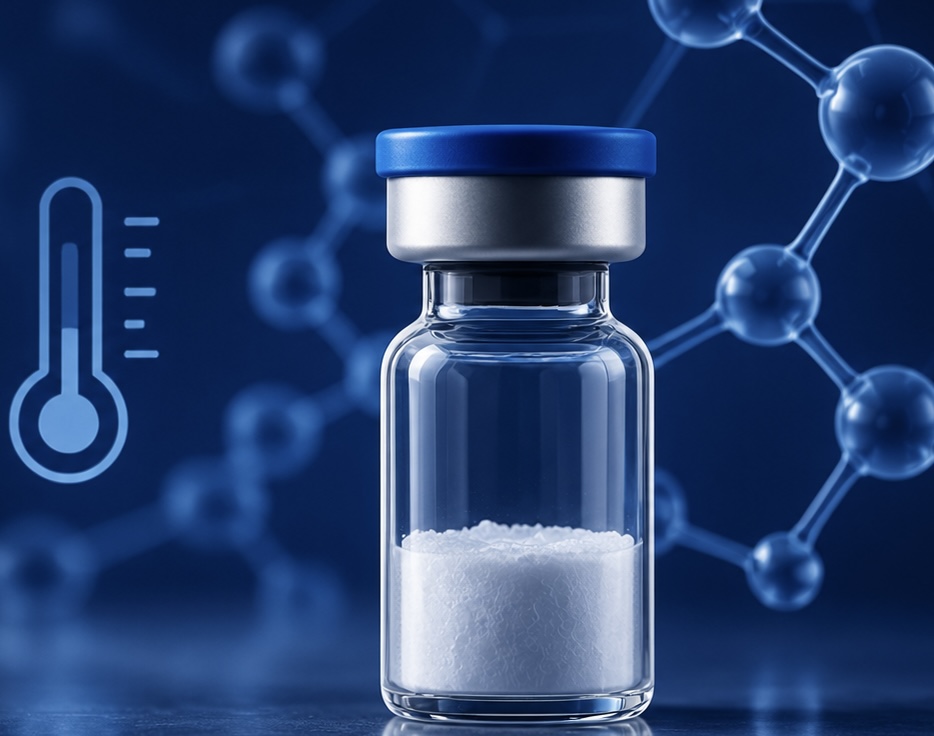
Lyophilization removes much of the water from a peptide preparation through a controlled freezing and drying process. By reducing available moisture, this process can slow certain hydrolytic and other moisture-dependent degradation reactions.
Consequently, many peptides exhibit improved storage stability in a properly prepared and stored lyophilized state compared with an aqueous solution. However, lyophilization does not eliminate all degradation pathways, and stability remains dependent on the peptide's molecular structure, formulation, residual moisture content, and storage environment.
Once a peptide is dissolved, additional factors become important, including solution pH, solvent composition, temperature, peptide concentration, and potential microbial contamination. Dissolved peptides may also be susceptible to aggregation, adsorption to container surfaces, or accelerated chemical degradation under certain conditions.
Because peptide stability varies by compound and formulation, storage conditions should be determined using peptide-specific stability information and available manufacturer documentation, rather than assuming that one storage protocol is suitable for all research peptides.
Main Research Findings
Temperature and Peptide Stability
Storage temperature is one of the most significant environmental factors influencing peptide stability and degradation.
In general, elevated temperatures can accelerate chemical reactions associated with peptide degradation, including hydrolysis, oxidation, and deamidation. Lower storage temperatures can slow many of these reactions, helping preserve peptide integrity and support consistent laboratory research.
Common laboratory peptide storage conditions include:
| Storage Condition | Temperature | General Laboratory Application |
|---|---|---|
| Refrigerated | 2–8°C (36–46°F) | Short-term storage when supported by peptide-specific stability data |
| Frozen | −20°C (−4°F) | Common longer-term storage condition for many lyophilized research peptides |
| Ultra-low temperature | −80°C (−112°F) | Extended storage of certain temperature-sensitive peptides and research preparations |
These temperatures represent common laboratory storage conditions rather than universal recommendations. Not all peptides require freezing, and lower temperatures do not automatically guarantee greater stability.
Appropriate peptide storage temperatures depend on the amino acid sequence, physical state, formulation, storage duration, and available stability data. Researchers should consult product-specific documentation and validated laboratory protocols when determining storage conditions.
Moisture Exposure and Chemical Degradation
Moisture exposure is an important consideration when storing lyophilized (freeze-dried) research peptides.
Some peptides and peptide formulations are hygroscopic, meaning they can absorb moisture from the surrounding atmosphere. Excess moisture may increase molecular mobility and accelerate certain degradation pathways, including hydrolysis and deamidation.
To minimize moisture-related instability, common laboratory practices include:
- Maintaining tightly sealed storage containers.
- Minimizing exposure to humid environments.
- Avoiding unnecessary opening and closing of peptide vials.
- Allowing sealed, refrigerated or frozen containers to equilibrate toward room temperature before opening, when appropriate, to reduce condensation.
Although lyophilization reduces moisture content, residual water may remain in the preparation. Consequently, maintaining appropriate storage conditions is important for preserving the stability of freeze-dried peptides.
Light Exposure and Oxidation
Exposure to light and oxygen can contribute to the chemical degradation of certain research peptides.
Some peptide structures are susceptible to photochemical reactions, particularly when exposed to ultraviolet radiation or prolonged light under unfavorable conditions. These reactions may alter susceptible amino acid residues and affect peptide integrity.
Oxidation is another potential degradation pathway. Amino acid residues such as methionine, cysteine, and tryptophan may undergo oxidative modification under certain environmental conditions.
Depending on the peptide's chemical characteristics, protective laboratory storage practices may include:
- Using amber glass vials or light-resistant containers.
- Keeping samples protected from unnecessary light exposure.
- Maintaining properly sealed containers.
- Minimizing unnecessary exposure to atmospheric oxygen.
The effectiveness of these approaches depends on the peptide, formulation, and storage environment. Not all peptides exhibit the same sensitivity to light or oxidation.
Freeze-Thaw Cycles and Solution Stability
Repeated freezing and thawing can influence the physical and chemical stability of certain peptide solutions.
Depending on the peptide and formulation, repeated freeze-thaw cycles may contribute to:
- Aggregation or precipitation: Changes in peptide solubility or intermolecular interactions may cause material to aggregate or precipitate.
- Changes in sample concentration: Precipitation, adsorption, or incomplete redissolution may affect the concentration of peptide available in solution.
- Chemical degradation: Certain formulations may experience degradation during freezing, thawing, or subsequent storage.
- Reduced experimental consistency: Changes in sample composition or physical state may introduce variability into laboratory results.
Where appropriate and supported by established laboratory procedures, dividing peptide solutions into smaller, single-use aliquots may help reduce unnecessary freeze-thaw cycles.
However, the effects of freezing and thawing vary according to peptide sequence, concentration, solvent composition, pH, and formulation. Some peptide solutions may remain stable through multiple cycles, while others may be more sensitive.
Researchers should evaluate freeze-thaw stability using peptide-specific information rather than assuming that all peptide solutions behave similarly.
Peptide Shelf Life and Long-Term Stability
There is no universal shelf life that applies to all research peptides.
Peptide shelf life depends on several factors, including molecular structure, initial purity, formulation, physical state, storage temperature, moisture exposure, and packaging conditions.
Lyophilized peptides may exhibit greater stability than their corresponding aqueous preparations under certain storage conditions. However, the duration of acceptable stability must be established using appropriate evidence rather than generalized storage estimates.
A peptide's physical appearance alone cannot reliably confirm its chemical identity, purity, or stability. Even when a sample appears unchanged, chemical modifications or degradation products may be present.
Analytical techniques such as high-performance liquid chromatography (HPLC) and mass spectrometry (MS) can help evaluate peptide purity, identity, and degradation-related changes.
For reliable laboratory research, researchers should refer to available certificates of analysis (COAs), manufacturer storage guidance, and relevant stability data when assessing whether stored peptide materials remain suitable for their intended experimental applications.
Research Methodology / Context
How Researchers Evaluate Peptide Stability
Peptide stability is evaluated through controlled laboratory studies designed to measure changes in chemical composition, purity, and physical properties under defined storage conditions.
In peptide stability studies, researchers may expose samples to different temperatures, humidity levels, light conditions, or solution environments over predetermined periods. Samples are analyzed at selected time points to identify potential degradation and evaluate how storage conditions influence peptide integrity.
Several analytical techniques are commonly used to assess peptide stability:
High-Performance Liquid Chromatography (HPLC)
High-performance liquid chromatography is widely used to separate peptide-related compounds and monitor changes in chromatographic purity. By comparing chromatographic profiles over time, researchers can detect certain degradation products and evaluate changes in sample composition.
Mass Spectrometry (MS)
Mass spectrometry helps characterize peptide identity and detect molecular mass changes associated with certain chemical modifications or degradation products. When combined with chromatographic techniques, such as liquid chromatography–mass spectrometry (LC-MS), it can provide additional information about peptide degradation pathways.
Stability-Indicating Analytical Methods
Validated stability-indicating analytical methods are designed to distinguish the target peptide from relevant degradation products and other interfering substances. These methods help researchers evaluate whether a peptide maintains its required quality characteristics throughout a defined storage period.
Controlled Storage Comparisons
Researchers may compare peptide samples maintained under different temperatures, humidity levels, or lighting conditions. Analytical measurements collected at predetermined intervals help identify storage-related changes and evaluate which conditions best preserve peptide stability.
Together, these approaches provide a scientific foundation for understanding peptide degradation and establishing evidence-based laboratory storage protocols.
Certificates of Analysis and Material Quality
Certificates of Analysis (COAs) provide documented analytical information about research materials based on testing performed on a specific batch or sample.
Depending on the testing program, a peptide COA may include:
- Peptide identity: Analytical information supporting the identity of the tested material.
- Reported purity: Results from analytical techniques such as HPLC.
- Batch identification: Information connecting the analytical results to a specific production or testing batch.
- Analytical testing results: Supporting data from techniques such as mass spectrometry or chromatography, when available.
COAs are valuable tools for evaluating initial material quality and supporting research documentation. However, a COA issued at the time of testing does not automatically establish long-term peptide stability or confirm suitability under all storage conditions.
Initial purity and storage stability are separate quality considerations. A peptide may meet its reported purity specifications at the time of analysis but undergo chemical or physical changes during subsequent storage.
For this reason, researchers should consider available COAs alongside peptide-specific storage recommendations, relevant stability studies, and appropriate analytical testing when evaluating research material quality over time.
Current Research Limitations
Although the general principles of peptide stability and degradation are well established, several limitations must be considered when applying laboratory storage recommendations to individual research peptides.
Peptide stability varies according to molecular structure, formulation, environmental conditions, and storage duration. Consequently, general storage practices cannot guarantee equivalent results across all peptide compounds.
Variability Between Peptide Sequences
Individual peptides differ in amino acid composition, molecular structure, and susceptibility to chemical degradation.
Certain peptide sequences may be more vulnerable to oxidation, hydrolysis, deamidation, or other degradation pathways under specific environmental conditions.
As a result, a storage temperature or handling procedure suitable for one peptide may not provide the same level of stability for another.
Peptide-specific stability information is therefore important when establishing reliable laboratory storage protocols.
Limited Compound-Specific Stability Data
Not all commercially available research peptides have extensive, publicly available stability studies.
In some cases, available research may examine a peptide under a limited range of temperatures, formulations, or storage durations.
Without sufficient compound-specific stability data, researchers may be unable to establish precise shelf-life estimates or predict how a material will behave under alternative storage conditions.
General peptide storage recommendations should therefore be interpreted as guidance rather than validated stability guarantees.
Differences Between Laboratory Formulations
The same peptide may exhibit different stability characteristics depending on its formulation and preparation.
Factors such as solvent composition, peptide concentration, solution pH, excipients, residual moisture, and packaging materials can influence chemical and physical stability.
For example, stability findings obtained from a lyophilized peptide preparation may not apply directly to the same peptide dissolved in an aqueous solution.
Similarly, results obtained using one solvent system or formulation may not accurately predict stability under different laboratory conditions.
Limitations of Visual Inspection
Visual inspection alone cannot reliably determine peptide purity, identity, or chemical stability.
A peptide sample may appear unchanged while containing degradation products or chemical modifications that are not visible to the naked eye.
Conversely, visible changes such as discoloration, cloudiness, or precipitation may indicate alterations in the sample but do not necessarily identify the underlying cause.
When confirmation of peptide integrity is necessary, appropriate analytical techniques, such as HPLC or mass spectrometry, may be required.
Storage Conditions Do Not Guarantee Purity
Refrigeration, freezing, moisture protection, and controlled handling can help reduce certain peptide degradation processes. However, these practices do not guarantee that a peptide will retain its original purity or stability indefinitely.
Even under carefully controlled laboratory conditions, some peptides may undergo gradual chemical or physical changes over time.
For this reason, general peptide storage guidelines should not replace validated product-specific storage instructions, available stability data, or appropriate analytical verification.
Understanding these limitations allows researchers to make more informed decisions about peptide storage, handling, and material quality throughout laboratory investigations.
Discussion
The Importance of Controlled Laboratory Storage
Proper peptide storage is an important component of maintaining material quality, chemical stability, and reliability in laboratory research.
Scientific studies of peptide degradation demonstrate that environmental factors, including temperature, moisture, light, oxygen, and handling conditions, can influence peptide integrity over time.
For many research peptides, lyophilization and appropriately controlled storage temperatures can help reduce certain degradation processes. However, storage requirements vary according to amino acid sequence, molecular structure, formulation, and physical state.
No single storage protocol is universally appropriate for all peptides. Researchers should prioritize compound-specific storage recommendations, available stability data, and validated laboratory procedures when determining appropriate storage conditions.
Supporting Research Reproducibility
Consistent peptide storage and handling practices contribute to reliable and reproducible experimental results.
Variations in storage temperature, environmental exposure, or sample handling may introduce chemical or physical changes that affect material composition and experimental consistency.
Maintaining accurate laboratory records helps researchers monitor storage conditions, identify potential sources of variability, and establish traceability throughout the research process.
Important documentation may include storage temperatures, sample preparation dates, batch or lot numbers, formulation details, and relevant handling conditions.
When appropriate, analytical verification can provide additional confidence that stored peptide materials continue to meet the quality requirements of a particular research application.
Laboratory Best Practices for Peptide Storage
Establishing a consistent peptide storage protocol can help researchers minimize unnecessary degradation risks and maintain reliable laboratory materials.
Recommended laboratory practices include:
- Review peptide-specific storage documentation. Consult available manufacturer guidance, stability information, and validated laboratory procedures before selecting storage conditions.
- Maintain appropriate storage temperatures. Use suitable laboratory refrigeration or freezing equipment with temperature monitoring when required by the material.
- Protect samples from moisture and light. Maintain properly sealed containers and minimize unnecessary environmental exposure.
- Limit temperature fluctuations and repeated handling. Reduce unnecessary container opening and repeated freeze-thaw cycles when relevant to the peptide formulation.
- Maintain accurate sample identification and records. Document batch numbers, preparation dates, storage conditions, and relevant handling information to support traceability.
- Use appropriate analytical testing when necessary. Techniques such as HPLC and mass spectrometry may help evaluate peptide identity, purity, and degradation-related changes.
Conclusion
Proper peptide storage plays an important role in preserving material integrity, maintaining chemical stability, and supporting reliable laboratory research.
Environmental factors such as temperature, moisture, light, oxygen, and repeated handling can influence peptide degradation over time. Although lyophilized peptides often demonstrate greater stability than corresponding aqueous solutions, optimal storage conditions depend on the peptide's molecular structure, formulation, and available stability data.
By following compound-specific storage recommendations, maintaining controlled laboratory environments, and documenting sample handling procedures, researchers can minimize avoidable degradation, preserve research material quality, and support experimental reproducibility.
At Peptide Purity USA, we emphasize research material quality, analytical transparency, and responsible laboratory practices. Our commitment to providing carefully sourced research peptides and available analytical documentation reflects the importance of consistency and scientific integrity in laboratory research.
Research Use Only: All peptides offered by Peptide Purity USA are intended strictly for laboratory research purposes. Not for human or veterinary consumption. Not intended for diagnostic or therapeutic applications.
References
- Recommendations for the Generation, Quantification, Storage and Handling of Peptides Used for Mass Spectrometry-Based Assays. 2016. Read publication.
- MilliporeSigma. Handling and Storage Guidelines for Peptides and Proteins. Technical laboratory guidance.
- MilliporeSigma. Handling and Storage of Synthetic Peptides. Technical peptide handling guide.