Introduction
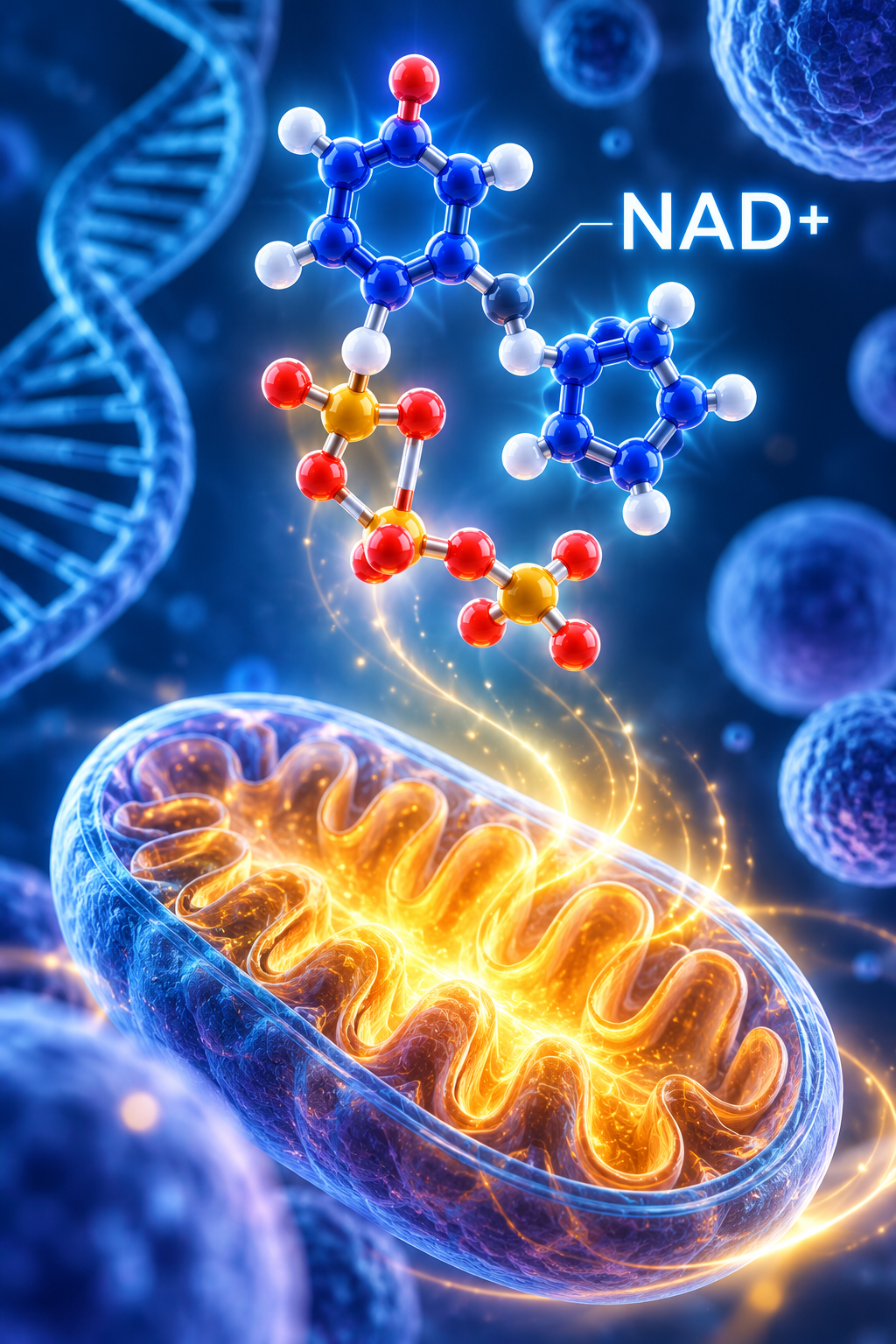
Nicotinamide adenine dinucleotide (NAD+) is an essential coenzyme found in virtually all living cells that plays a central role in cellular energy production, metabolic regulation, and numerous biological processes.
NAD+ participates in biochemical reactions that help cells convert nutrients into usable energy. It also serves as a critical component of cellular pathways involved in DNA repair, stress responses, and the maintenance of normal cellular function.
Scientific interest in NAD+ has expanded because of its relationship with mitochondrial function, cellular metabolism, and biological aging.
Researchers have investigated how NAD+ levels change under different physiological conditions and whether alterations in NAD+ metabolism contribute to age-associated cellular dysfunction.
Studies involving NAD+ precursors, metabolic enzymes, and NAD+-dependent signaling pathways have provided valuable insights into how this coenzyme supports cellular health and metabolic regulation.
However, although NAD+ is essential for normal cellular function, the potential benefits of increasing NAD+ levels through supplementation or other interventions remain areas of ongoing scientific investigation.
Understanding the biological functions of NAD+ provides an important foundation for exploring the relationship between cellular energy production, mitochondrial activity, and aging-related molecular pathways.
Research Background
What Is NAD+?
Nicotinamide adenine dinucleotide (NAD+) is a naturally occurring coenzyme present in virtually all living cells. It plays an essential role in cellular metabolism by participating in biochemical reactions involved in energy production and cellular regulation.
Nicotinamide adenine dinucleotide exists in two interconvertible oxidation states:
NAD+ (oxidized form): Accepts electrons during metabolic reactions, typically through the transfer of a hydride ion.
NADH (reduced form): Carries reducing equivalents that can contribute to cellular energy production.
The conversion between NAD+ and NADH is essential for numerous oxidation-reduction reactions involved in cellular metabolism.
Unlike hormones or signaling peptides, NAD+ is a dinucleotide coenzyme that functions as both an electron carrier and a substrate for certain cellular enzymes involved in signaling and metabolic regulation.
NAD+ and Cellular Energy Production
One of the most established functions of NAD+ is its participation in cellular energy metabolism.
During the breakdown of carbohydrates, fats, and other nutrients, NAD+ accepts reducing equivalents and is converted into NADH.
NADH can subsequently donate electrons to the mitochondrial electron transport chain, contributing to the electrochemical gradient used to support the production of adenosine triphosphate (ATP) through oxidative phosphorylation.
ATP serves as the primary energy currency used by cells to perform essential biological functions, including cellular maintenance, molecular transport, and biochemical synthesis.
The availability of NAD+ and the balance between NAD+ and NADH are therefore important factors in maintaining cellular redox balance and regulating metabolic activity.
NAD+ and Biological Aging
Researchers have increasingly investigated the relationship between NAD+ metabolism and biological aging.
Experimental studies have identified age-associated changes in NAD+ availability in certain tissues and organisms, suggesting potential connections between NAD+ metabolism and cellular aging processes.
These changes may involve several biological mechanisms, including:
Alterations in NAD+ biosynthesis and recycling pathways
Changes in the activity of NAD+-consuming enzymes, including CD38 and poly(ADP-ribose) polymerases (PARPs)
Changes in mitochondrial metabolism and cellular redox balance
Cellular stress responses and inflammatory signaling
Alterations in DNA damage responses and cellular maintenance pathways
However, NAD+ levels do not decline uniformly across all tissues, organisms, or individuals. The extent and biological significance of age-associated changes in NAD+ availability remain subjects of ongoing scientific investigation.
Current research continues to examine whether changes in NAD+ metabolism directly contribute to age-associated cellular dysfunction or primarily reflect broader alterations in metabolism and physiological regulation.
Main Research Findings
NAD+ and Mitochondrial Function
Mitochondria are cellular structures responsible for producing much of the adenosine triphosphate (ATP) required for biological activity.
NAD+ plays an essential role in mitochondrial energy metabolism by participating in oxidation-reduction reactions that support cellular respiration and ATP production.
During metabolic processes, NAD+ is converted into NADH, which can donate electrons to the mitochondrial electron transport chain. This process contributes to the electrochemical gradient used to generate ATP through oxidative phosphorylation.
Researchers have investigated how changes in NAD+ availability influence mitochondrial metabolism, cellular energy regulation, and responses to physiological stress.
Preclinical studies suggest that interventions targeting NAD+ metabolism can influence certain mitochondrial pathways, including processes associated with cellular respiration and metabolic adaptation.
However, increasing NAD+ concentrations does not necessarily result in improved mitochondrial performance or greater ATP production.
Mitochondrial function depends on multiple interacting biological systems, including nutrient availability, enzyme activity, respiratory chain efficiency, cellular redox balance, and energy demand.
These findings highlight the importance of NAD+ in mitochondrial biology while demonstrating that its relationship with cellular energy production is complex.
NAD+ and DNA Repair
Another important area of scientific investigation involves the relationship between NAD+ metabolism and cellular DNA damage responses.
NAD+ serves as a substrate for a family of enzymes known as poly(ADP-ribose) polymerases (PARPs), which participate in cellular responses to DNA damage and help regulate certain repair-associated processes.
When DNA damage occurs, the activity of certain PARP enzymes may increase, resulting in greater NAD+ consumption.
PARPs use NAD+ to generate ADP-ribose modifications that participate in signaling processes associated with DNA damage detection, repair coordination, and cellular stress responses.
Researchers have investigated how sustained activation of NAD+-consuming enzymes may influence intracellular NAD+ availability, cellular metabolism, and energy regulation.
Experimental findings suggest that NAD+ metabolism is closely connected to mechanisms involved in genome maintenance and cellular responses to stress.
However, these relationships are complex, and increasing NAD+ availability has not been established as a reliable method of improving DNA repair or preventing age-associated diseases in humans.
NAD+ and Sirtuin Signaling
Sirtuins are a family of NAD+-dependent enzymes involved in the regulation of numerous cellular processes.
These enzymes use NAD+ as a substrate for enzymatic reactions that modify proteins and influence cellular signaling pathways.
Sirtuin-related research has identified potential roles in:
Metabolic regulation and energy balance
Cellular stress responses
Gene expression and chromatin regulation
Mitochondrial function and metabolic adaptation
Protein modification and cellular maintenance
Because sirtuins depend on NAD+ for their enzymatic activity, researchers have investigated whether changes in NAD+ availability influence sirtuin-associated signaling pathways.
Experimental studies have demonstrated interactions between NAD+ metabolism and certain sirtuin-mediated processes, including pathways associated with cellular metabolism and stress adaptation.
However, the biological effects depend on the specific sirtuin enzyme, tissue type, cellular conditions, and experimental model.
Furthermore, increasing NAD+ levels does not necessarily result in increased activity across all sirtuin-dependent pathways.
The relationship between NAD+ and sirtuins remains an important area of investigation for understanding how cellular metabolism interacts with biological aging.
NAD+ and Age-Associated Metabolic Changes
Scientific research has also examined whether alterations in NAD+ metabolism are associated with changes in glucose regulation, skeletal muscle function, mitochondrial activity, and metabolic adaptation during aging.
Preclinical investigations have reported that certain interventions targeting NAD+ biosynthesis or recycling pathways can influence metabolic measurements under specific experimental conditions.
These findings have encouraged further investigation into the relationship between NAD+ availability and age-associated physiological changes.
Human clinical studies involving NAD+ precursors, including nicotinamide riboside (NR) and nicotinamide mononucleotide (NMN), have demonstrated that some interventions can increase measured NAD+ concentrations or related metabolites in blood and selected tissues.
However, these biochemical changes have not consistently translated into clinically meaningful improvements in glucose metabolism, skeletal muscle performance, mitochondrial function, or other health outcomes.
Differences in study populations, intervention duration, formulations, and measurement methods may contribute to variability in reported findings.
Additionally, results involving NAD+ precursors should not be interpreted as direct evidence for the effectiveness of externally administered NAD+.
Overall, current research demonstrates the importance of distinguishing measurable changes in NAD+ metabolism from established improvements in physiological function or human health.
Research Methodology / Context
Scientific investigations involving NAD+ use a variety of experimental approaches to examine its biological functions, metabolic regulation, and potential relationship with cellular aging.
These studies range from controlled laboratory experiments to animal models and human clinical investigations, each providing different levels of scientific evidence.
Laboratory and Cellular Studies
In vitro studies allow researchers to examine NAD+ metabolism under controlled laboratory conditions and investigate its involvement in cellular energy production, mitochondrial function, and biochemical signaling pathways.
These investigations may evaluate:
NAD+ and NADH concentrations and their relative balance
Cellular metabolic activity and ATP production
Mitochondrial respiration and oxidative phosphorylation
NAD+-dependent enzyme activity, including sirtuins and PARPs
Cellular responses to oxidative stress, metabolic stress, and DNA damage
Researchers may use analytical techniques such as liquid chromatography–mass spectrometry (LC-MS) to quantify NAD+-related metabolites, alongside biochemical assays and cellular respiration measurements.
These methods help identify molecular mechanisms and clarify how NAD+ metabolism interacts with cellular signaling and energy regulation.
However, findings from isolated cells or laboratory-controlled systems do not necessarily reflect the complexity of whole-organism physiology.
Animal Research
Preclinical studies have investigated NAD+ metabolism in animal models of aging, metabolic dysfunction, mitochondrial alterations, and cellular stress.
Researchers may examine the effects of modifying NAD+ biosynthesis, recycling pathways, or the activity of NAD+-consuming enzymes.
Experimental investigations may also evaluate changes in tissue-specific NAD+ availability, mitochondrial function, metabolic regulation, and physiological responses under controlled conditions.
These studies provide valuable insight into biological mechanisms and help identify potential research directions for further investigation.
Nevertheless, differences in metabolism, physiology, and experimental conditions mean that findings from animal models cannot automatically be generalized to humans.
Human Clinical Research
Human clinical studies have investigated interventions intended to influence NAD+ metabolism, particularly oral NAD+ precursors such as nicotinamide riboside (NR) and nicotinamide mononucleotide (NMN).
Researchers have evaluated changes in circulating and tissue-specific NAD+-related biomarkers, glucose metabolism, skeletal muscle function, and selected physiological outcomes.
Some clinical investigations have demonstrated measurable increases in NAD+ concentrations or related metabolites following precursor supplementation.
However, clinical findings remain mixed, and changes in NAD+ biomarkers have not consistently translated into meaningful improvements in metabolic function, physical performance, or aging-related health outcomes.
Furthermore, research involving oral NAD+ precursors should not be interpreted as direct evidence supporting the safety or effectiveness of externally administered NAD+.
Different compounds, formulations, routes of administration, and experimental conditions may produce substantially different biological effects.
Continued clinical research is necessary to clarify the relationship between NAD+ metabolism, measurable biochemical changes, and meaningful physiological outcomes.
Current Research Limitations
Despite growing scientific interest in NAD+ metabolism, several important limitations remain in understanding its relationship with cellular function, metabolic regulation, and biological aging.
Although laboratory and preclinical investigations have identified significant biological roles for NAD+, translating these findings into established human health outcomes remains challenging.
Differences Between Experimental Models
NAD+ metabolism varies across tissues, organisms, cellular compartments, and physiological conditions.
Results observed in cultured cells or animal models may not accurately predict responses in humans because of differences in metabolic regulation, enzyme activity, and biological complexity.
Additionally, experimental conditions used in laboratory studies may not reflect normal physiological environments.
These differences highlight the importance of validating preclinical findings through appropriately designed human investigations.
Inconsistent Measurements of NAD+ Levels
Scientific studies may measure NAD+ concentrations in whole blood, specific blood cell populations, skeletal muscle, or other biological tissues.
These measurements are not necessarily interchangeable because NAD+ availability and metabolism can differ substantially between tissues and cellular compartments.
Analytical methods, sample collection procedures, and storage conditions may also influence measured NAD+ concentrations.
Consequently, changes in circulating NAD+ biomarkers may not accurately represent NAD+ availability within mitochondria or other intracellular compartments.
Standardized measurement approaches remain important for improving consistency and comparability across studies.
Limited Evidence for Anti-Aging Benefits
Although NAD+ metabolism is involved in several biological pathways associated with aging, increasing NAD+ levels has not been demonstrated to reverse human biological aging or extend human lifespan.
Preclinical investigations have reported changes in certain age-associated biological processes following interventions targeting NAD+ metabolism.
However, these findings do not establish equivalent benefits in humans.
Current clinical evidence remains insufficient to conclude that increasing NAD+ availability prevents age-related diseases, meaningfully improves longevity, or consistently restores age-associated physiological function.
Further controlled human studies are necessary to determine whether changes in NAD+ metabolism produce measurable and clinically meaningful outcomes.
Uncertainty Regarding Long-Term Interventions
Long-term safety and effectiveness data remain limited for many interventions intended to alter NAD+ metabolism.
Important research questions include the biological effects of sustained changes in NAD+ availability, tissue-specific responses, differences among formulations, and potential interactions with existing physiological conditions.
Additionally, the effects of NAD+-targeting interventions may vary depending on the compound, route of administration, duration of exposure, and individual metabolic characteristics.
Longer-term clinical investigations are needed to better understand these variables and establish reliable safety profiles for specific interventions.
Distinguishing NAD+ From Its Precursors
NAD+, nicotinamide riboside (NR), and nicotinamide mononucleotide (NMN) are chemically distinct compounds that participate in related metabolic pathways.
NR and NMN can serve as precursors in NAD+ biosynthesis, while NAD+ itself functions directly as a coenzyme and substrate for various cellular enzymes.
Although these compounds are biologically connected, differences in absorption, metabolism, cellular transport, and biochemical conversion may influence their physiological effects.
Therefore, research findings involving NR or NMN should not automatically be applied to externally administered NAD+.
This distinction is essential when interpreting experimental findings, evaluating clinical studies, and drawing conclusions about NAD+-targeting interventions.
Discussion
The Importance of NAD+ in Cellular Biology
NAD+ is a fundamental component of cellular metabolism, participating in biochemical reactions essential for energy production, metabolic regulation, and cellular maintenance.
Its dual role as an electron carrier and a substrate for NAD+-dependent enzymes connects cellular energy metabolism with signaling pathways involved in DNA damage responses, stress adaptation, and protein regulation.
The relationship between NAD+ metabolism and mitochondrial function is particularly important because cellular energy production depends on coordinated interactions between metabolic pathways, enzyme activity, and intracellular redox balance.
Research involving sirtuins, poly(ADP-ribose) polymerases (PARPs), and NAD+ biosynthesis pathways has expanded scientific understanding of how cellular metabolism interacts with maintenance and stress-response mechanisms.
Together, these findings demonstrate that NAD+ is not simply involved in energy production but also participates in a broader network of cellular regulatory processes.
Understanding NAD+ and Aging Research
The relationship between NAD+ metabolism and biological aging has become an important area of scientific investigation.
Preclinical studies suggest that changes in NAD+ availability may influence certain age-associated biological processes, including mitochondrial metabolism, cellular stress responses, and NAD+-dependent enzyme activity.
However, biological aging involves multiple interacting mechanisms, including genomic instability, changes in gene regulation, mitochondrial dysfunction, cellular senescence, inflammatory signaling, and altered metabolic regulation.
NAD+ metabolism represents one component of this complex biological network rather than an independent explanation for aging.
Although experimental studies have reported changes in aging-associated biological pathways following interventions targeting NAD+ metabolism, these findings do not establish equivalent effects in humans.
Current clinical evidence does not demonstrate that increasing NAD+ levels independently slows or reverses human biological aging or extends human lifespan.
Future investigations must clarify which changes in NAD+ metabolism contribute directly to age-associated dysfunction, how these effects differ across tissues, and whether targeted interventions produce meaningful, reproducible physiological outcomes.
Regulatory and Safety Considerations
NAD+ is a naturally occurring coenzyme essential for normal cellular function. However, its biological importance should not be interpreted as evidence that externally administered NAD+ is safe or effective for treating medical conditions.
NAD+ is not FDA-approved as an anti-aging treatment or as a general therapy for improving energy, longevity, or metabolic health.
Although certain NAD+ precursors, including nicotinamide riboside (NR) and nicotinamide mononucleotide (NMN), have been investigated in human clinical studies, these findings do not establish the safety or effectiveness of injectable NAD+ or other forms of externally administered NAD+.
The biological effects and potential risks of NAD+-targeting interventions may vary according to the compound, formulation, concentration, route of administration, duration of exposure, and individual physiological characteristics.
For injectable preparations, additional considerations include sterility, endotoxin contamination, formulation compatibility, and other quality-related factors.
Long-term safety, clinical effectiveness, and the broader physiological consequences of sustained changes in NAD+ metabolism require further investigation through appropriately designed human studies.
Research materials should be handled according to established laboratory safety procedures, compound-specific documentation, and applicable regulatory requirements.
Conclusion
Nicotinamide adenine dinucleotide (NAD+) is an essential coenzyme involved in cellular energy production, metabolic regulation, DNA damage responses, and numerous biological signaling pathways.
Scientific research has established its central role in oxidation-reduction reactions and its importance as a substrate for enzymes involved in cellular maintenance, metabolic regulation, and stress responses.
Investigations have also identified important relationships between NAD+ metabolism, mitochondrial function, and age-associated biological changes, contributing to growing scientific interest in its role in cellular aging.
However, while NAD+ is necessary for normal cellular function, the potential benefits of increasing NAD+ availability through supplementation or other external interventions remain uncertain.
Current human clinical evidence has not established that NAD+-targeting interventions reverse biological aging, extend human lifespan, or consistently improve metabolic function and physical performance.
Further research is necessary to clarify tissue-specific NAD+ regulation, long-term biological effects, and whether interventions targeting NAD+ metabolism can produce meaningful and reproducible physiological outcomes.
At Peptide Purity USA, we emphasize research material quality, analytical transparency, and responsible laboratory practices to support scientific investigation.
Research Use Only: All research materials offered by Peptide Purity USA are intended strictly for laboratory research purposes. Not for human or veterinary consumption. Not intended for diagnostic or therapeutic applications.
References
- -Lautrup S, et al. Roles of NAD+ in Health and Aging. Cold Spring Harbor Perspectives in Medicine. 2024.
- -ME, Ziegler M, Baur JA. Regulation of and challenges in targeting NAD+ metabolism. Nature Reviews Molecular Cell Biology.
- -Vinten KT, et al. NAD+ precursor supplementation in human ageing: clinical evidence and challenges. Nature Metabolism. 2025;7:1974–1990.
- -Zhang J, et al. Emerging strategies, applications and challenges of targeting NAD+ in the clinic. Nature Aging. 2025.